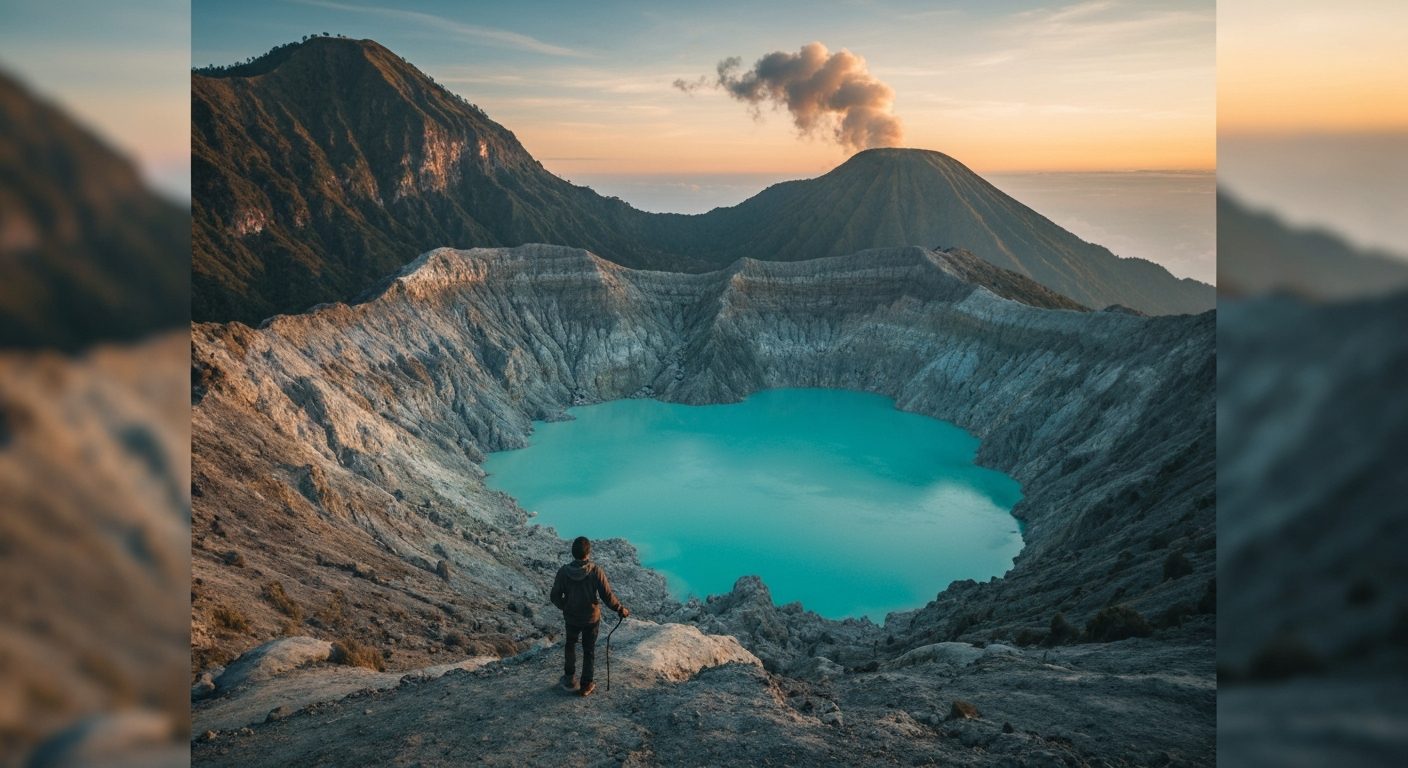
Ijen vs Bromo which better? The honest answer is that Kawah Ijen delivers a rarer, more physical night hike and electric-blue fire, while Mount Bromo offers easier access and classic sunrise views – most travellers get the best experience by combining both.
As someone who has walked Ijen’s crater trail more than a hundred times, and stood on Bromo’s caldera rim in every season, I’ll say this upfront: these volcanoes don’t replace each other. They complement each other.
Ijen vs Bromo: The Core Experience Compared
Both are active volcanoes in East Java, both sit inside protected national parks, and both can be reached on short trips from Bali or Surabaya. The feeling on each mountain, though, is completely different.
| Aspect | Kawah Ijen (Ijen Plateau) | Mount Bromo (Bromo Tengger Semeru NP) |
|---|---|---|
| Signature moment | Electric-blue sulfur flames at night + turquoise crater lake at first light | Wide-angle sunrise over smoking Bromo, Batok and Semeru above a sea of clouds |
| Typical start time | 00:00–01:00 hotel pick-up, hike starts ~01:30–02:00 | 02:30–03:00 hotel pick-up for sunrise viewpoint |
| Hike distance | ~3 km up + 3 km down; optional extra 1–1.5 km into sulfur basin | Short walks from viewpoints; 10–30 minutes each |
| Elevation gain | ~500 m ascent from Paltuding to crater rim (~1,850–2,386 m above sea level) | Viewpoints by jeep (~2,700 m); crater stair climb ~250 steps |
| Physical intensity | Moderate to hard night hike; steep and sustained | Easy to moderate; most time in 4WD jeep or on easy paths |
| Gas & sulfur | Active sulfur mine; gas masks strongly recommended near crater | Occasional sulfur smell; gas mask rarely needed on standard viewpoints |
| Photography focus | Long-exposure blue fire, crater lake, miners, Milky Way (in season) | Layered volcano silhouettes, sunrise colours, “sea of sand” textures |
| Best for | Active travellers, night photographers, guests who want a challenge | First-timers to Java, families, those wanting big views with easier walking |
| Indicative cost (last verified June 2026) |
Private Ijen night trek from Bali/Banyuwangi: ~US$130–260 per person depending on group size and origin | Private Bromo sunrise tour from Surabaya/Malang: ~US$120–240 per person depending on route and hotel class |
If your question is “Ijen crater blue fire vs sunrise which better?”, ask yourself what you value more: a rare geological phenomenon you can feel in your lungs and legs, or a more relaxed morning with huge, classic volcano views.
Ijen Blue Fire Tour vs Mount Bromo Sunrise Tour
Here’s how the signature experiences stack up when you put an Ijen blue fire tour vs Mount Bromo sunrise tour side by side.
Kawah Ijen: The Midnight Descent to the Blue Fire
A typical private Ijen night trek with our licensed East Java guides, arranged by Bali Premium Trip, runs like this:
- Pick-up around midnight from your hotel in Banyuwangi, Bondowoso, or from the Bali–Java ferry.
- Drive 60–90 minutes to Paltuding, the park gate and trailhead.
- Start hiking around 01:30–02:00 under headlamps.
The first hour is a steady grind. The path is wide but consistently uphill on compacted volcanic gravel. At around 2.3 km you reach the crater rim. This is where most people first smell the sulfur strongly and feel the wind change.
From there, if the crater is open and your guide judges conditions safe, those who are fit enough can descend around 30–45 minutes down a rocky, uneven trail into the sulfur basin. Gas masks go on. Conversations get shorter. You hear the roar of the vents before you see the flames.
The blue fire itself looks smaller to the naked eye than in long-exposure photos, but it moves and shifts. It’s alive. Under dark skies, you watch the electric-blue tongues dance across the vents, sometimes with miners only a few metres away working their night shift. By 04:00–04:30, the flames start to fade as dawn approaches.
Then you climb back to the rim in time to watch the turquoise crater lake appear as the sky lightens. The lake’s color is not a camera trick. It comes from its high acidity and dissolved minerals. The entire basin is one of the most acidic crater lakes on Earth, and you feel that in your throat in the form of dry, metallic air.
Mount Bromo: Sunrise Above the “Sea of Sand”
A typical private Mount Bromo sunrise tour runs very differently:
- 02:30–03:00 pick-up from your hotel in Cemoro Lawang, Sukapura, Probolinggo, or from Surabaya/Malang for a longer transfer.
- Transfer to a 4WD jeep organised through licensed local drivers inside the Bromo Tengger Semeru National Park zone.
- Drive 30–60 minutes to a sunrise viewpoint such as Penanjakan, King Kong Hill, or Seruni Point.
You share the predawn with a line of jeeps and a few warung stalls selling hot tea and instant noodles. The walk to the viewpoint is short – 10 to 20 minutes on a dirt or paved path, with optional stairs.
As the sky lightens, you see the full layout of the caldera: the flat “sea of sand,” Mt. Batok’s perfect cone, Mount Bromo with its smoking crater, and Mt. Semeru often sending up a distant ash plume. On a clear, dry-season morning, this is one of Indonesia’s most recognisable volcanic panoramas.
After sunrise, you descend by jeep onto the sand plain and walk or ride a horse towards the base of Bromo. A concrete stairway of around 250 steps takes you to the crater rim. The air here can carry sulfur, but nothing like Ijen’s mining basin. Most visitors manage it comfortably without gas masks.
Ijen vs Bromo Difficulty: How Hard Are They Really?
Guests often ask “Bromo or Ijen for first timers?” and “Is Ijen harder than Bromo?” Here is a clear, experience-based Ijen vs Bromo difficulty overview.
Ijen: A Real Night Hike, Not a Stroll
- Distance & elevation: Around 3 km from Paltuding to crater rim with ~500 m vertical gain. Optional extra 1–1.5 km round-trip into the basin.
- Time on feet: 1.5–2.5 hours up for most guests, 45–90 minutes down, plus 45–90 minutes inside the crater if open.
- Trail: Wide dirt and gravel early, steeper, rockier sections near the rim and inside the crater.
- Altitude: The rim sits around 2,300–2,400 m. Most healthy travellers feel only mild shortness of breath.
For many, the challenge is the combination of steep gradient, cold air, and the time of night. Muscles feel heavier at 02:00. Heart rates climb faster than expected. If you descend into the sulfur basin, add uneven rocks, some scrambling and sulfur gas that can make your eyes and throat sting even through a mask.
This is not a technical climb. But it’s a real hike, and we recommend it only for guests with reasonable fitness and no uncontrolled respiratory or heart problems. Your pace is your own, and we plan extra time so you don’t have to rush.
Bromo: Easier Walking, More Time in the Jeep
- Distance & elevation: Short walks to viewpoints (often less than 1 km one way). Around 250 steps to Bromo’s crater rim.
- Time on feet: Typically 15–30 minutes at each stop.
- Altitude: Sunrise viewpoint around 2,700 m; many guests are driven most of the way.
The biggest physical demand is usually the early wake-up and standing in cool wind at the viewpoint, not the walking itself. For guests with limited mobility, a customised jeep-only itinerary can still deliver rewarding views.
So, for Ijen vs Bromo comparison on difficulty: Ijen is clearly tougher on the legs and lungs. Bromo is more accessible to a wider range of ages and fitness levels.
Access and Logistics: From Bali, Banyuwangi, Bondowoso and Surabaya
Any serious Ijen vs Bromo comparison has to cover how you actually reach each volcano. This is where the Ijen and Bromo combo tour starts to make sense.
Reaching Kawah Ijen
Kawah Ijen lies in East Java, with main access from:
- Banyuwangi: The closest city, roughly 1.5–2 hours’ drive from Paltuding. Bali Premium Trip often bases guests here for direct night treks.
- Bondowoso: A quieter inland town, roughly 2–3 hours from the trailhead depending on road and stop choices.
- Bali: From North or West Bali, expect 4–6 hours including the ferry crossing to Java, depending on your starting point and crossing schedule.
We arrange private transport via our East Java network, including ferry timings, so you do not have to manage local transfers at midnight tired and half-asleep.
Reaching Mount Bromo
Bromo has several access hubs:
- Surabaya: East Java’s main city, with an airport connected to Jakarta and Bali. Drive to the Bromo area typically takes 3–4 hours.
- Malang: Another common gateway, similar driving time to the Bromo perimeter.
- Cemoro Lawang / Sukapura: Villages right next to the park boundary, used as overnight bases for sunrise tours.
From these towns, your Bali Premium Trip coordinator arranges a 4WD jeep operated by licensed local drivers who are authorised to enter the Bromo Tengger Semeru National Park area and familiar with the latest park rules and routes.
Logistics for an Ijen and Bromo Combo Tour
If you are thinking “should I visit Ijen or Bromo?” and you have at least three full days, our honest advice is: plan both. A typical Ijen and Bromo combo tour runs 3–5 days, with:
- One night near Ijen (Banyuwangi or Bondowoso).
- One night near Bromo (Cemoro Lawang or similar).
- Road transfer between the two, usually via Probolinggo.
There is no commercial flight or train directly linking Ijen and Bromo; the connection is by road, generally 6–8 hours with breaks. This is where a private car with a driver who knows both regions saves a lot of friction.
If you’d like us to sketch out a realistic route and timing for your dates, you can plan your trip with our Bali Premium Trip reservations team via email or WhatsApp. We operate everything directly and coordinate the licensed local guides and jeeps on your behalf.
Blue Fire vs Sunrise: Timing, Season and Chances
Mount Bromo sunrise vs Ijen blue fire are both light-dependent experiences. They’re not guaranteed, and smart timing improves your odds.
Seasonality for Ijen
- Dry season (roughly May–October): Generally clearer skies at night, better chance of seeing the Milky Way and having a less slippery trail. Winds can be stronger on the rim.
- Rainy season (roughly November–April): More cloud and rain, especially in the afternoons. Night conditions can still be good, but heavy rain or strong gas can lead park authorities to close the crater descent without notice.
The blue fire is a function of hot sulfur gas igniting on contact with oxygen. It is not a “seasonal event”, but it is easier to see clearly on dark, dry, less windy nights with lower ambient light. Even then, visibility can vary. Park rangers sometimes stop access into the crater entirely if gas levels or wind direction are unsafe. We respect those decisions and will keep you at the rim if that is what the authorities require.
Seasonality for Bromo
- Dry season: Often clearer dawn skies and better-defined mountain layers, but with more dust on the sea of sand and more visitors.
- Rainy season: Fewer travellers, but dawn clouds can obscure the view or cover the caldera. Sometimes that cloud layer sits in the valley with clear peaks above, which can be very photogenic.
Sunrise is daily; what changes is how much of the view you actually see. No operator can guarantee a perfect sunrise or a particular cloud formation, so plan for the experience, not a specific photograph.
Photography Payoff: Which Volcano Rewards the Camera More?
For photographers comparing Ijen vs Bromo, which better suits you depends on style and tolerance for difficult shooting conditions.
Why Photographers Choose Ijen
- Blue fire: Long exposure work on a moving subject in near darkness. Tripods and fast lenses help. Gas can be hard on equipment; bring protection and be ready to work quickly.
- Crater lake: High-contrast scenes at blue hour and after sunrise. Polarising filters can be useful, but be careful near the rim edge.
- Miners and details: Ethical distance and respect are important – these are people at work, not models.
You shoot at night, in gas, often with gloves and mask on. It is demanding but rewarding if you value unusual volcanic imagery.
Why Photographers Choose Bromo
- Layered landscapes: Telephoto lenses compress Batok, Bromo and Semeru into classic volcanic layers.
- Flexible angles: Multiple viewpoints allow different compositions over one or two mornings.
- Golden-hour friendly: You shoot at dawn and after sunrise in easier light, with less environmental stress on gear than at Ijen’s crater floor.
If your primary goal is one strong, iconic volcano shot with lower risk to equipment, Bromo usually wins. If you want unique, more technically challenging work, Ijen has the edge.
Cost Overview: Ijen vs Bromo
Prices change with season, hotel class and group size. But to ground your planning, here are indicative private tour ranges (last verified June 2026):
- Private Ijen night trek (from Banyuwangi/Bondowoso)
- Roughly US$130–220 per person for 2–4 guests, including transport, guide, basic gas mask rental and park entry charged at official rates. Solo travellers typically pay more per person due to fixed car and guide costs.
- Private Ijen night trek from Bali (with ferry)
- Roughly US$190–260 per person for 2–4 guests, depending on Bali starting point and ferry timing, again with official park fees and local guide included.
- Private Bromo sunrise tour from Surabaya/Malang (1 night near Bromo)
- Roughly US$120–240 per person for 2–4 guests, including private car, 4WD jeep inside the park, licensed local guide where required, park entry at official rates and simple accommodation options.
- Ijen and Bromo combo tour (3–4 days)
- Typically around US$320–650 per person for 2–4 guests, depending on routing, hotel standard and how many private transfers you add between Bali, Ijen, Bromo and Surabaya.
We do not add hidden third-party markups. You book directly with Bali Premium Trip’s team at transparent, published ranges, and we in turn arrange jeeps, drivers and additional local guides with licensed partners in Banyuwangi, Bondowoso, Probolinggo and Bromo village areas.
Who Should Choose Ijen, Bromo, or Both?
“Should I visit Ijen or Bromo?” depends less on which volcano is “better” and more on who you are and how you like to travel.
Best Choice for Active Travellers and Hikers
If you like earning your view, are comfortable hiking 6–8 km in a night with 500 m elevation gain, and are curious about geology and human labour at close range, Ijen should be on your list. The blue fire and crater lake reward that effort.
For you, Bromo is a strong second volcano: less effort, but a powerful sense of landscape. If you can spare the time, the Ijen and Bromo combo tour makes sense.
Best Choice for Families and Casual Walkers
Bromo suits mixed-ability groups and families better. The jeep-based approach, short walks, and flexible viewpoints mean grandparents and children can often enjoy the experience together, with options to rest in the vehicle if needed.
Ijen’s night hike and sulfur exposure can be too much for younger children, guests with asthma, or anyone who is not comfortable walking steadily uphill for up to two hours. For these groups, we generally recommend Bromo first, and then a careful, individual assessment before adding Ijen.
Best Choice for First-Time Visitors to Java
For many first-timers with limited time, Bromo is the more straightforward introduction: simpler logistics from Surabaya, abundant accommodation near the park, and an experience that feels accessible even if you are not an experienced hiker.
If you are reasonably fit, have 3–4 days and are curious about Ijen, though, you will likely never regret adding it. Ijen feels more intense and less “developed” than Bromo, in the sense that you spend more time walking on the mountain itself rather than on viewing platforms.
Best Choice for Photographers
- Landscape and travel photographers: Do both if you can. Bromo for clean sunrise compositions, Ijen for blue fire and the crater lake.
- Those on a strict, short schedule: Pick Bromo if you want higher odds of at least some usable images in one dawn, or Ijen if you prioritise unique, high-impact but harder-won shots.
If You Only Have One Night
- From Surabaya or Malang: Choose Bromo. Travel times make Ijen unrealistic as an out-and-back in a single night from these cities.
- From North/West Bali or Banyuwangi: Choose Ijen. You can cross to Java, rest, then start a midnight hike without wasting hours on the road inland.
Safety, Gas Masks and Realistic Expectations
Neither volcano is a theme park. Both are active systems managed by Indonesian authorities with rules that can change daily depending on volcanic activity, weather and crowd levels.
Gas and Respiratory Concerns at Ijen
- Gas masks: We strongly recommend and arrange proper filter masks for all guests entering the crater area, and many prefer to wear them on the rim as well.
- Who should be cautious: Guests with asthma, chronic bronchitis, heart disease or pregnancy should discuss Ijen carefully with us beforehand. In some cases, we may advise enjoying the rim view only or choosing Bromo instead.
- Crater closures: Rangers can prohibit descent without advance notice. That is for your safety, and we respect those decisions even if it means no blue fire viewing that night.
Altitude and Cold
Both Ijen and Bromo sit between roughly 2,300 and 2,700 m at their main viewpoints. Most healthy travellers feel only mild effects: faster breathing, slightly lower stamina. Nights can be cold, often in the single digits Celsius with wind chill on exposed ridges.
We suggest layering: base layer, fleece, windproof outer shell, hat and gloves. Jeans and a light hoodie are not enough for everyone at 03:30 on a windy vulcanic rim.
Trail Conditions and Footwear
Ijen’s trail is not technical but can be slippery with dust or rain. Inside the crater, rocks are uneven, and you need both hands free. We recommend proper closed shoes with good grip; sandals are not safe on the descent.
At Bromo, the main risks are loose sand on the stairway and crowding during peak periods. Take your time, use the railings where available, and listen to your guide’s instructions on where to stand near the crater edge.
Our role as Bali Premium Trip and Ijen Blue Fire Tours is to share clear information and put you in the hands of licensed local guides who know current conditions. Only you can judge your own fitness and comfort with exposure to altitude, cold and sulfur gas.
Why Most Travellers Don’t Have to Choose
For many guests, the real answer to “Ijen vs Bromo which better?” is: “Both, in sequence.” Ijen gives you a raw night on an active sulfur volcano. Bromo follows with a more relaxed, panoramic sunrise that lets everything you saw at Ijen sink in.
A well-paced 3–4 day Ijen and Bromo combo tour, operated directly by Bali Premium Trip with vetted, licensed East Java guides, balances the intensity of Ijen with the accessibility of Bromo. You leave with a sense of how different two active volcanoes only a day’s drive apart can feel – in your legs, lungs and camera.
If you’d like to match a route to your fitness, time and starting point (Bali, Banyuwangi, Bondowoso, Surabaya or beyond), you can plan your trip with our reservations team. We’re available on email and WhatsApp to talk through real departure times, night-hike pacing and what each option genuinely demands.
FAQs: Ijen vs Bromo
Is Ijen harder than Bromo?
Yes. Ijen involves a 3 km uphill night hike with about 500 m elevation gain, and an optional steep descent into a sulfur-filled crater. Bromo’s standard sunrise tour relies mostly on jeeps with short walks and stairs, so it is gentler for most visitors.
Can I see both Ijen blue fire and Bromo sunrise in one trip?
Yes, if you have at least 3 days. A common route is Bali or Banyuwangi to Ijen for the blue fire night trek, then by road to the Bromo area for sunrise the next morning or the one after. We arrange the transfers, hotels, guides and jeeps as a continuous itinerary.
Is the blue fire at Ijen guaranteed?
No. The blue fire depends on volcanic gas, wind and visibility. Even on active nights, rangers may close the crater descent if gas levels or wind direction are unsafe. You will still see the crater lake and sunrise from the rim, but blue fire access cannot be promised.
Which is better for families: Bromo or Ijen?
Mount Bromo is usually better for families and older travellers. The jeep-based approach, short walks and more moderate sulfur exposure make it more manageable. Ijen suits families with older teenagers who are fit, used to hiking and comfortable with gas masks and steep night trails.
How much does an Ijen and Bromo combo tour cost?
As an indicative range last verified in June 2026, a 3–4 day private combo for 2–4 guests typically falls between about US$320 and US$650 per person, depending on origin city, hotel standard and how many transfers you include. For a clear, up-to-date quote, contact our Bali Premium Trip team via email or WhatsApp through the plan your trip page.