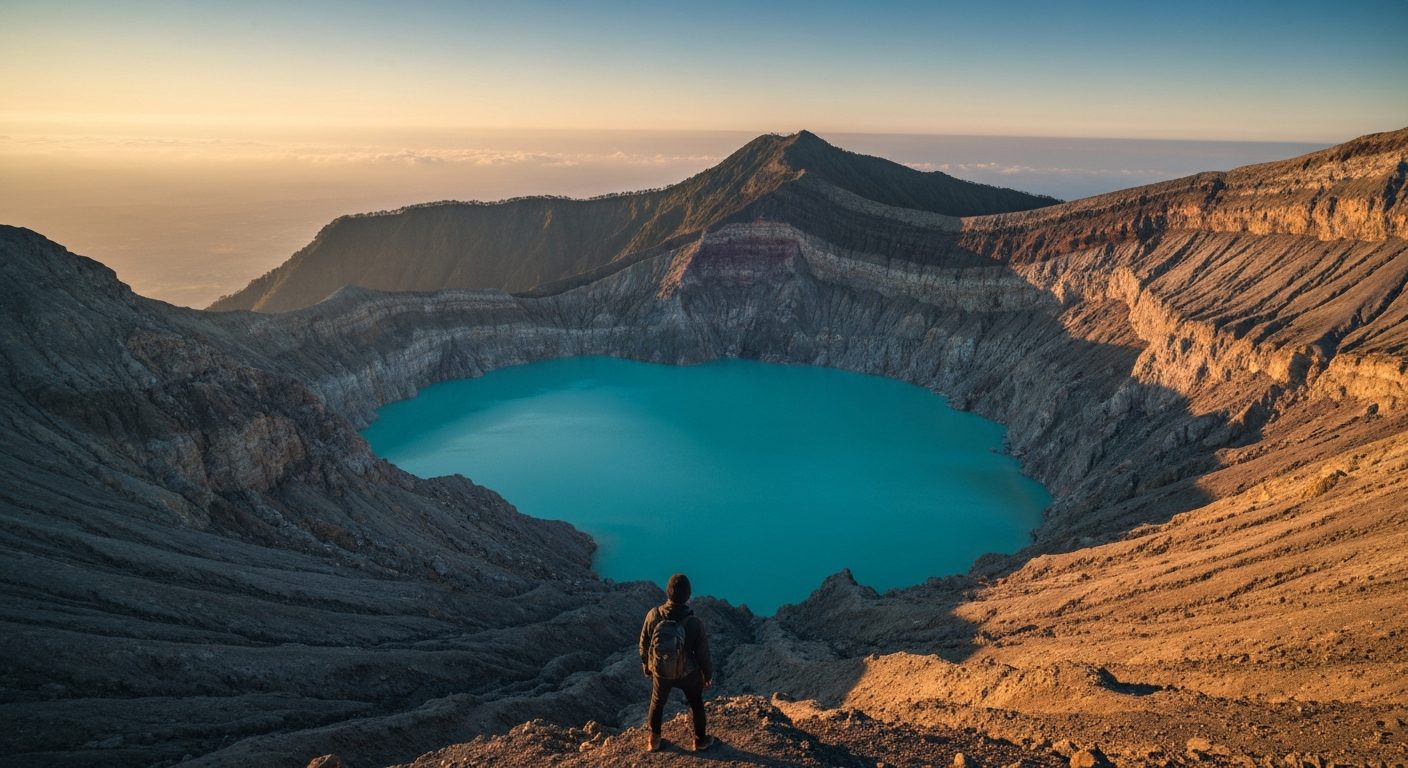
For many travelers, figuring out how to get to Ijen from Bali is the first step toward witnessing one of Indonesia’s most extraordinary natural phenomena: the electric-blue flames of Kawah Ijen. This guide covers the entire overland journey, detailing the Ketapang ferry route and all essential logistics.
As a night-and-landscape photographer who has spent countless pre-dawn hours framing the blue flames and the miners’ lamplit climb, I’m here to share the reality of this journey. It’s an adventure, certainly, but one that requires planning and a clear understanding of the route, the hours, and the conditions. This isn’t a casual day trip; it’s a significant overland expedition that rewards careful preparation.
The blue fire is not always easy to reach, but the effort is profound. Let’s break down exactly how to visit Kawah Ijen from Bali, step by step, ensuring you arrive prepared and ready for the experience.
The Journey Begins: Bali to Gilimanuk Port
Your journey from Bali to Ijen starts long before you even consider the ferry. The initial leg involves traveling from your accommodation in Bali – typically from areas like Ubud, Denpasar, Seminyak, Canggu, or Uluwatu – to Gilimanuk Port, located on Bali’s westernmost tip. This drive is substantial, setting the stage for the expedition ahead.
Pickup Points and Drive Times
Most travelers opt for a private car or an arranged transfer for this segment. Public transport, while available, significantly extends travel time and adds complexity, especially in the dead of night.
- From South Bali (Seminyak, Canggu, Kuta, Denpasar, Sanur): Expect a drive of approximately 3 to 4 hours to reach Gilimanuk Port. The roads are generally good, but traffic can be unpredictable, especially during peak hours or around Denpasar.
- From Ubud: The drive from Ubud to Gilimanuk is comparable, also taking around 3 to 4 hours. You’ll traverse central Bali before heading west.
- From Bali Airport (DPS): If you’re arriving directly and heading straight to Ijen, be prepared for a drive of at least 4 hours to Gilimanuk Port, depending on traffic around the airport and city. This makes an Ijen Crater tour from Bali 1 day extremely challenging, almost impossible if you want to experience the blue fire and sunrise comfortably.
The timing of this drive is critical. To catch the blue fire, which is best seen between 2 AM and 4 AM, your departure from Bali will be in the late afternoon or early evening. This means much of your drive will be in the dark.
The Gilimanuk Ferry Route
The route to Gilimanuk is straightforward, mainly following a coastal road once you clear the more populated areas. While comfortable, it’s not particularly scenic at night. The focus is on reaching the port efficiently. This leg forms the initial part of the Denpasar to Ijen Blue Fire via Gilimanuk ferry route.
Crossing the Strait: Gilimanuk to Ketapang Ferry Logistics
The ferry crossing from Gilimanuk, Bali, to Ketapang Port in Banyuwangi, East Java, is the logistical heart of the Bali to Ijen Ketapang ferry tour. This is where you transition from island to island.
Ferry Frequency and Duration
The good news is that the ferries operate 24 hours a day, 7 days a week. They depart with remarkable frequency, typically every 15 to 30 minutes, meaning you rarely wait long. This constant flow is essential for ensuring smooth Ketapang ferry Bali to Java Ijen logistics.
The crossing itself is relatively short. Expect the ferry ride to last approximately 45 to 60 minutes. It’s a quick, often breezy journey across the Bali Strait.
Ferry Experience and Cost
The ferries are large, utilitarian vessels designed for transporting people, cars, and trucks. They have basic seating, often an open-air deck, and sometimes small kiosks selling snacks and drinks. Don’t expect a luxury cruise; it’s purely functional.
- Passenger Fare: For walk-on passengers, the cost is quite low, around IDR 10,000-15,000 (roughly US$0.65-1.00) per person. (Last verified June 2026)
- Vehicle Fare: If you’re taking a car across, the fare is significantly higher, typically in the range of IDR 150,000-200,000 (around US$10-13) per vehicle, plus passenger fees. (Last verified June 2026)
The process is generally efficient. You’ll pay at a ticket booth before boarding, then drive or walk onto the ferry. Once docked at Ketapang, you disembark and continue your journey into Java.
Arriving in Java: Ketapang to Banyuwangi Base
Upon arrival at Ketapang Port, you are officially in Banyuwangi Regency, East Java. This area serves as the primary gateway and staging point for Kawah Ijen.
Banyuwangi as the Staging Point
Banyuwangi city and its surrounding areas are where most travelers choose to stay before and after their Ijen trek. It offers a range of accommodation options, from budget guesthouses to more comfortable hotels. It’s a relatively quiet city, focused on its port, agriculture, and increasing tourism.
How to Get to Kawah Ijen from Banyuwangi
From Ketapang Port or your accommodation in Banyuwangi, the next leg of the journey is to the Ijen base camp, known as Paltuding. This is where the trek begins.
- Drive Time to Paltuding: The drive from Banyuwangi city to Paltuding takes approximately 1.5 to 2 hours. The road winds through local villages, coffee plantations, and eventually ascends into the cooler mountain air. The final section of the road can be steep and winding, requiring a reliable vehicle and an experienced driver.
- Timing for Blue Fire: For the blue fire experience, you’ll typically depart from your Banyuwangi accommodation around midnight or 1 AM to reach Paltuding by 2 AM, allowing enough time for the trek and descent into the crater.
Many choose to spend at least one night in Banyuwangi. Arriving in the evening, getting some rest, and then departing for the midnight trek is the most sensible approach. Attempting to drive directly from Bali, trek Ijen, and return to Bali in one continuous push, especially for the blue fire, is physically grueling and not recommended for safety or enjoyment.
The Midnight Ascent: Ijen Blue Fire Tour from Bali Timeline
This is the core of the Ijen experience, the reason for the long journey. The blue fire of Kawah Ijen is a truly unique spectacle, demanding an overnight trek.
When the Blue Fire Appears
The electric-blue flames are actually ignited sulfuric gas, emerging from cracks in the volcano at high pressure and temperature. For optimal visibility, darkness is essential. The best time to witness the blue fire is between 2 AM and 4 AM. As the first hints of dawn begin to lighten the sky around 4:30 AM, the blue flames become fainter and eventually disappear with the sunrise, which occurs around 5:30 AM.
Trek Details: Duration, Difficulty, Conditions
The hike to the crater rim from Paltuding is a moderate climb. It’s not Everest, but it’s not a stroll in the park either.
- Trek to Rim: The ascent to the crater rim typically takes 1.5 to 2 hours, covering a distance of about 3 kilometers with an elevation gain of approximately 400 meters. The trail is well-trodden but can be steep and sandy in places.
- Descent to Blue Fire Point: From the crater rim, if conditions allow and your guide deems it safe, you’ll descend into the crater to get closer to the blue flames. This descent takes roughly 45 minutes. The path is rough, rocky, and often slippery due to loose scree and sulfur deposits. This is the most challenging part of the trek. Miners will be ascending and descending this same path, carrying heavy loads of sulfur. Always give them right of way.
- Altitude and Cold: Kawah Ijen’s summit stands at approximately 2,799 meters (9,183 feet) above sea level. Even in tropical Indonesia, temperatures at the rim can drop significantly overnight, often between 5-10°C (41-50°F). Warm layers are not just recommended; they are mandatory.
- Sulfur and Gas Exposure: This is the critical safety factor. The air inside the crater, especially near the blue flames, is rich with sulfur dioxide gas. It’s pungent, can irritate the eyes and throat, and in higher concentrations, can be dangerous. This is why a gas mask is absolutely essential.
Gas Mask and Safety
As a safety editor, I cannot stress this enough: wear your gas mask in the blue fire zone. Our tours, arranged by Bali Premium Trip, ensure you are provided with a proper gas mask. Do not attempt to buy a cheap dust mask; it offers no protection against sulfur dioxide. Listen to your guide. They are licensed local experts familiar with the conditions, wind changes, and safe zones. If the wind shifts and blows gas your way, retreat immediately. Your safety is paramount.
Sunrise Experience
After witnessing the blue fire, most trekkers ascend back to the crater rim to watch the sunrise. This is a spectacular experience, as the first light illuminates the turquoise crater lake, the surrounding peaks, and the sulfur mining operation. The lake itself is incredibly acidic and vibrant, a sight that contrasts sharply with the pre-dawn darkness.
This completes the core Ijen blue fire tour from Bali experience before you begin the descent back to Paltuding.
Your Options for Visiting Kawah Ijen from Bali
Planning your Ijen tour from Bali involves choosing the right logistical approach. There are generally three ways to tackle this journey, each with its own trade-offs.
- Self-Organized Trip
-
Pros: Maximum flexibility on schedule, potentially lower direct costs for transport if using public options.
Cons: High logistical complexity. Requires booking multiple transfers (Bali car, ferry tickets, Java car to Banyuwangi, Java car to Paltuding, local guide at Ijen). Risk of miscommunication or delays. Finding a reliable local guide at Paltuding late at night can be challenging. No guarantee of proper gas masks or safety briefings.
Best for: Experienced, independent travelers comfortable with navigating local transport and language barriers in a foreign country, often on a tighter budget.
- Private Driver (Bali-Java Round Trip)
-
Pros: More comfortable and direct than public transport. Driver handles the vehicle and ferry crossing. Still offers some flexibility on timing.
Cons: Can be expensive as you’re paying for the driver’s time, vehicle, and ferry crossing for the car/driver. You still need to arrange a local Ijen guide separately once you reach Paltuding, which adds another layer of coordination and potential cost. The driver might not be familiar with the Ijen trek logistics or safety protocols.
Best for: Small groups or families prioritizing comfort over cost, but still wanting a degree of independence for the Ijen trek itself.
- All-Inclusive Ijen Tour from Bali (Bali Premium Trip)
-
Pros: Zero logistical stress. All transfers (Bali pickup, ferry crossing, Java transfers to Banyuwangi and Paltuding), an experienced licensed local Ijen guide, park permits, and essential safety gear (like gas masks) are pre-arranged. Seamless, safe, and efficient. Our Bali Premium Trip team ensures you book directly with us at transparent, published rates with no third-party markup. We arrange all third-party services, such as park jeeps, guides, and permits, via vetted, licensed local partners.
Cons: Generally the most expensive option upfront, but often provides the best value when considering convenience, safety, and peace of mind. Less flexibility once the itinerary is set.
Best for: First-timers to Ijen, those prioritizing safety and comfort, and travelers who want to focus purely on the experience without worrying about the complex logistics of an Ubud to Ijen blue fire overnight tour via ferry.
Can You Do an Ijen Crater Tour from Bali in 1 Day?
While technically possible, an Ijen Crater tour from Bali 1 day is extremely demanding and not recommended, especially if you aim for the blue fire. It would involve leaving Bali in the early afternoon, driving, ferrying, driving to Ijen, trekking for several hours, then immediately turning around for the entire return journey. This creates a continuous 20+ hour ordeal with minimal rest, significantly increasing fatigue and safety risks. For the blue fire, an overnight tour is essential.
Considering a Bromo Ijen Tour from Bali?
Many travelers combine Ijen with a trip to Mount Bromo. A Bromo Ijen tour from Bali is a popular multi-day option, extending your adventure through East Java’s volcanic landscape. Bali Premium Trip can also arrange these comprehensive tours, connecting you with trusted local partners for a smooth experience across both iconic destinations.
Realistic Timelines: How Long Does it Take?
Understanding the full duration of the journey is crucial for planning. This is not a short hop; it’s a significant expedition.
Let’s consider a typical overnight Ijen Blue Fire Tour from Bali, starting from a South Bali location:
- Day 1 Evening (e.g., 6:00 PM): Pickup from your Bali accommodation (e.g., Denpasar, Ubud, Kuta).
- Day 1 Evening (6:00 PM – 9:30 PM): Drive from South Bali to Gilimanuk Port (~3.5 hours).
- Day 1 Night (9:30 PM – 10:30 PM): Gilimanuk to Ketapang Ferry Crossing & Disembarkation (~1 hour).
- Day 1 Night (10:30 PM – 12:30 AM): Drive from Ketapang to Banyuwangi accommodation (~2 hours). Check-in and short rest.
- Day 2 Early Morning (12:30 AM – 2:00 AM): Drive from Banyuwangi accommodation to Paltuding base camp (~1.5 hours).
- Day 2 Pre-Dawn (2:00 AM – 4:00 AM): Trek to Ijen crater rim, descend to blue fire point, witness blue fire.
- Day 2 Dawn (4:00 AM – 5:30 AM): Ascend to rim, watch sunrise, explore crater lake surroundings.
- Day 2 Morning (5:30 AM – 7:30 AM): Descend from Ijen back to Paltuding.
- Day 2 Morning (7:30 AM – 9:00 AM): Drive from Paltuding back to Banyuwangi for breakfast and rest.
- Day 2 Late Morning (11:00 AM): Check out from Banyuwangi hotel.
- Day 2 Lunchtime (11:00 AM – 1:00 PM): Drive from Banyuwangi to Ketapang Port (~2 hours).
- Day 2 Afternoon (1:00 PM – 2:00 PM): Ketapang to Gilimanuk Ferry Crossing & Disembarkation (~1 hour).
- Day 2 Afternoon (2:00 PM – 5:30 PM): Drive from Gilimanuk back to your Bali drop-off point (~3.5 hours).
This timeline demonstrates that the total elapsed time from Bali pickup to Bali drop-off for an overnight tour is roughly 23-24 hours, with significant periods of driving and trekking. It’s a full day and night of adventure, emphasizing the need for proper rest and preparation.
Safety on the Mountain: My Editor’s Perspective
As the Blue Fire Photography & Safety Editor, my primary concern is always your well-being. The allure of Ijen is powerful, but it comes with inherent risks that must be respected.
Gas Masks and Sulfur Exposure
The air quality inside the Ijen crater, particularly near the blue flames, can be poor. Sulfur dioxide is a strong irritant, causing coughing, shortness of breath, and eye watering. A good-quality gas mask with an active carbon filter is non-negotiable for anyone descending into the crater. Our arranged tours provide these. If you feel unwell, or if the wind shifts and you are enveloped in a plume of gas, immediately signal your guide and move to higher ground. Your health is more important than any photograph.
Fitness and Gear
The trek itself is of moderate difficulty. It’s a steady uphill climb on uneven terrain, followed by a steep, rocky descent into the crater. You don’t need to be an athlete, but good general fitness is required. If you have respiratory issues, heart conditions, or significant mobility challenges, consult your doctor before attempting this trek.
Essential gear includes:
- Sturdy hiking shoes: With good ankle support and grip.
- Warm layers: Jacket, hat, gloves, scarf. It gets genuinely cold.
- Headlamp: Absolutely necessary for the pre-dawn trek.
- Water and snacks: Hydration is key.
- Basic first-aid items: Blister plasters, pain relievers.
- Gas mask: Provided on our tours.
Altitude
At nearly 2,800 meters, Kawah Ijen is at an altitude where some people can start to feel the effects of reduced oxygen, such as mild headaches or shortness of breath. Pace yourself, hydrate, and listen to your body.
The Cold
I’ve spent countless nights up there. The cold is real. When you’re waiting for the blue fire, or for sunrise, stationary for long periods, those low single-digit temperatures cut through thin clothing quickly. Layer up, seriously.
The blue fire and the turquoise lake are incredible sights. By preparing thoroughly and respecting the mountain’s conditions, you ensure your adventure is not only memorable but also safe and comfortable.
Planning Your Ijen Blue Fire Adventure
Traveling from Bali to Ijen is a commitment, a journey that tests your resolve but rewards you with a truly unique experience. The honest truth is that the logistics can be complex, and safety is paramount.
To remove the stress of coordinating multiple transfers, finding reliable local guides, and ensuring you have the right safety gear, consider booking an all-inclusive tour. Our Bali Premium Trip team specializes in arranging these seamless overland expeditions, ensuring you book directly with us at transparent, published rates. We arrange licensed local guides and comfortable transfers, allowing you to focus entirely on the incredible blue fire and the sunrise over the crater lake.
Ready to witness the electric blue flames of Kawah Ijen?
Plan your trip with us today. Our reservations team can assist you directly via WhatsApp to tailor your perfect Ijen adventure.
Frequently Asked Questions About Getting to Ijen from Bali
Can you do an Ijen Crater tour from Bali in 1 day?
While technically possible, doing an Ijen Crater tour from Bali in 1 day is extremely strenuous, involving over 20 hours of continuous travel and trekking with minimal rest. It’s strongly recommended to opt for an overnight tour with a stay in Banyuwangi to experience the blue fire safely and comfortably.
What gear do I need for the Ijen blue fire trek?
You’ll need sturdy hiking shoes with good grip, warm layers (jacket, hat, gloves, scarf) as temperatures drop to 5-10°C, a headlamp, water, snacks, and a proper gas mask to protect against sulfur fumes. Our tours provide gas masks and experienced guides.
Is the Ijen blue fire trek safe?
The trek can be safely undertaken with proper preparation and adherence to safety guidelines. Key safety measures include wearing a gas mask in the crater, following your licensed local guide’s instructions, dressing warmly, staying on marked paths, and maintaining a moderate fitness level. Always respect the mountain’s conditions and the advice of your guide.
What’s the best time of year to visit Ijen?
The dry season, from April to October, is generally considered the best time to visit Ijen. During these months, the weather is more stable, with clearer skies and less rain, which makes for better trekking conditions and clearer views of the blue fire and crater lake.
How much does it cost to get to Ijen from Bali?
The cost varies significantly based on your chosen method. A self-organized trip using public transport might range from US$50-100 per person (excluding Ijen park fees and guide), while a private driver from Bali could be US$200-400 for the vehicle (plus Ijen fees). An all-inclusive private tour from Bali, arranged by Bali Premium Trip, typically ranges from US$150-300 per person for an overnight tour, covering transfers, guides, permits, and safety gear. (Last verified June 2026, prices are indicative and vary by group size and inclusions).