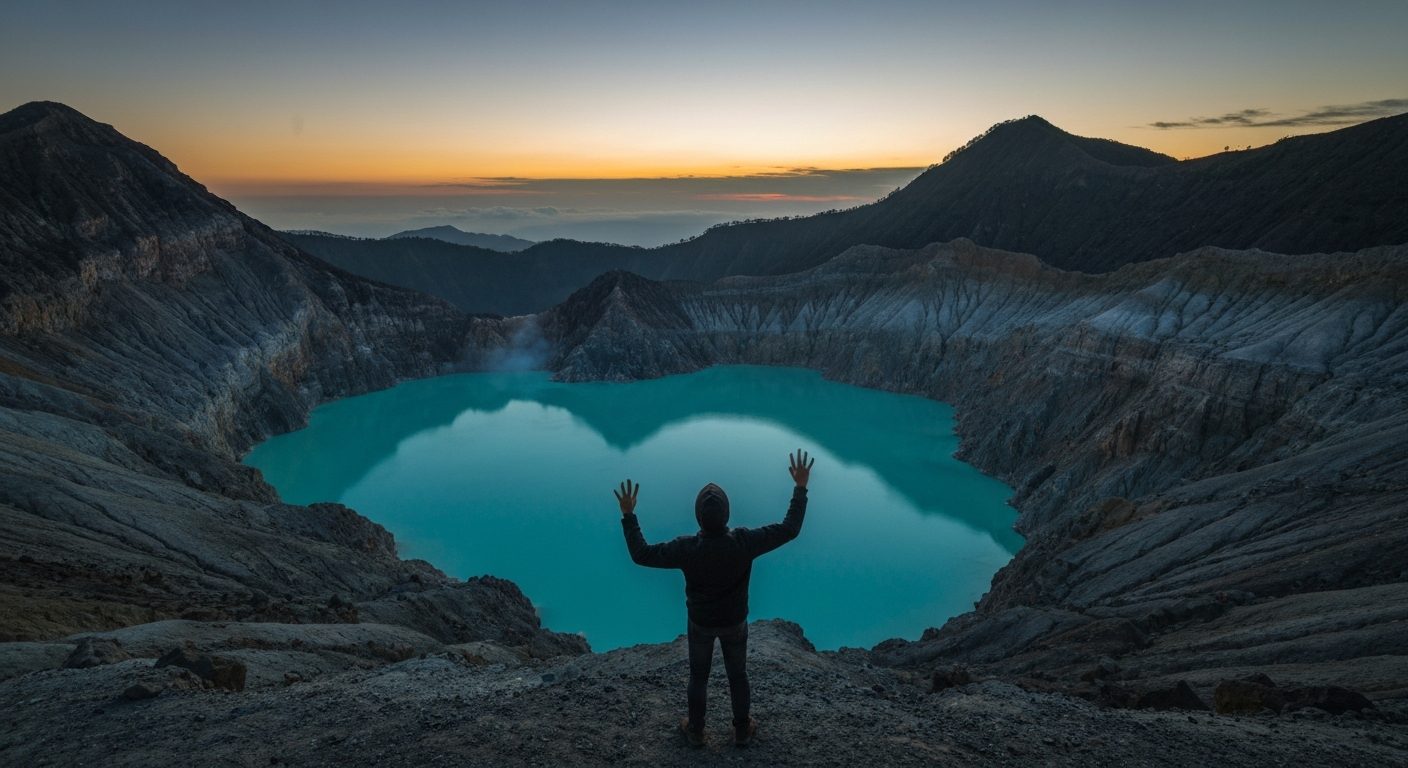
Capturing Kawah Ijen’s electric-blue fire at night is an experience unlike any other, and knowing how to photograph Ijen blue fire at night is key to bringing home images that truly convey its otherworldly glow. This guide offers practical, expert advice on camera settings and techniques, ensuring you’re prepared to capture both the elusive blue flames and the turquoise crater lake at sunrise.
As the Editor at Ijen Blue Fire Tours, I’ve trekked to Kawah Ijen’s crater rim more than a hundred times. I understand the challenges: the extreme darkness, the altitude, the corrosive sulfur gas, and the fleeting nature of the blue fire itself. This isn’t a trek for the unprepared, nor is it a simple point-and-shoot photography scenario. My goal is to equip you with the knowledge needed to navigate these conditions and make the most of your camera, transforming a challenging environment into an opportunity for truly unique photographs.
Before we into the technicalities, a crucial reminder: safety always comes first. Kawah Ijen is an active volcano, and conditions can change rapidly. Park authorities periodically restrict access to the crater floor and the blue fire for safety reasons. Visibility of the blue fire is never guaranteed, dependent on wind, sulfur concentration, and other natural factors. These are photography tips, not a promise of access or visibility. Always follow the instructions of your licensed guide and park rangers. For a comprehensive understanding of the trek’s difficulty, what to expect with gas masks, and how to prepare for the altitude and cold, please refer to our detailed guides on these topics.
The Unique Challenges of Photographing Ijen’s Blue Fire
Photographing Kawah Ijen’s blue fire isn’t like shooting a city skyline or a daytime landscape. It presents a specific set of hurdles that demand careful preparation and precise execution. Understanding these challenges is the first step toward overcoming them.
Extreme Low Light Conditions
The blue fire is visible only in near-total darkness, meaning you’ll be operating your camera in an environment with virtually no ambient light. This is where your camera’s low-light performance, lens aperture, and long exposure techniques become critical. Your eyes will adjust, but your camera sensor needs help.
The Corrosive Sulfur Gas
Kawah Ijen is an active sulfur mine, and the blue flames are, in fact, ignited sulfuric gases. This means you will be in the presence of sulfur dioxide, a corrosive gas that can irritate your eyes, lungs, and skin. More importantly for photographers, it can also damage camera electronics and lenses. Protecting your gear is non-negotiable.
Dealing with Headlamps and Other Light Sources
While your own headlamp is essential for safety, and other trekkers will be using theirs, these light sources can introduce unwanted light pollution into your long-exposure shots. You’ll need strategies to shield your lens or compose shots to minimize their impact. The blue fire itself is a relatively dim light source compared to a bright headlamp.
The Dynamic Nature of the Flames
The blue flames are not static. They flicker, surge, and shift with the wind and the rate of gas emission. This dynamism can be beautiful to capture, but it also means you might need multiple attempts to get the perfect “still” shot, or embrace the motion blur that long exposures will naturally create.
Altitude and Cold
The Kawah Ijen crater rim sits at an elevation of 2,386 meters (7,828 feet) above sea level, and the trek begins from Paltuding at around 2,300 meters (7,546 feet). The air is thin, and temperatures can drop significantly, especially in the early morning hours before dawn. Cold weather drains camera batteries much faster than usual, and your own comfort and dexterity will be affected.
Essential Gear for Ijen Blue Fire Night Photography
To successfully capture the blue fire, specific camera gear is not just recommended, but often required. Investing in or borrowing the right tools will make a significant difference.
Camera Body Recommendations
For optimal results in extreme low light, a camera body with excellent high-ISO performance is paramount.
- Full-Frame Cameras: These generally offer superior low-light performance and dynamic range compared to crop-sensor cameras. Models like the Sony Alpha 7 series (e.g., A7 III, A7 IV, A7S III), Canon EOS R series (e.g., R6, R5), or Nikon Z series (e.g., Z6, Z7) are highly capable.
- Crop-Sensor Cameras: While full-frame is ideal, many modern crop-sensor cameras (APS-C) can still perform well, especially if paired with a fast lens. Look for models known for good noise control at higher ISOs.
Regardless of sensor size, ensure your camera has full manual control (M mode) for all settings.
Lenses for Blue Fire Photography
A “fast” lens with a wide aperture (low f-number) is crucial for letting in as much light as possible.
- Wide-Angle Prime or Zoom Lens: A lens with an aperture of f/2.8 or wider (e.g., f/1.8, f/1.4) is highly recommended. Focal lengths in the 14mm to 35mm range (on full-frame) are excellent for capturing both the blue fire and some of its surroundings.
- Examples: Sony FE 16-35mm f/2.8 GM, Canon RF 15-35mm f/2.8L IS USM, Nikon Z 14-24mm f/2.8 S, or faster primes like a 24mm f/1.4.
- The wider angle allows you to capture more of the scene, providing context to the flames. The fast aperture shortens your necessary shutter speed or allows for a lower ISO, reducing noise.
The Indispensable Tripod
This is non-negotiable for long exposure photography.
- Sturdy and Stable: Choose a tripod that can hold your camera and lens securely without shaking, even in windy conditions or on uneven ground. Carbon fiber tripods are lighter for trekking but can be more expensive.
- Compact for Travel: Since you’ll be carrying it up a volcano, consider its weight and folded size.
Remote Shutter Release or Timer
To avoid any camera shake when pressing the shutter button for long exposures, use either:
- A wired or wireless remote shutter release.
- Your camera’s built-in 2-second delay timer. This allows any vibrations from pressing the button to dissipate before the shutter opens.
Batteries, Batteries, Batteries
The cold temperatures at Ijen will rapidly drain your camera batteries.
- Carry at least 2-3 fully charged spare batteries. Keep them warm in an inside pocket until needed.
- Consider a power bank if your camera supports USB charging in-camera.
Protecting Your Gear from Sulfur
The corrosive sulfur gas is a real threat to your camera’s sensitive electronics and optics.
- Plastic Bags/Rain Covers: Bring several sturdy plastic bags (like Ziploc freezer bags or dedicated camera rain covers) to completely enclose your camera and lens when not actively shooting. Seal them as much as possible.
- Lens Wipes/Microfiber Cloths: Sulfur can leave a fine residue. Gently wipe your lens elements with a dedicated lens cloth. Avoid rubbing harshly, as sulfur particles can be abrasive.
- Minimal Exposure: Keep your camera out only when you are actively composing and shooting.
- Professional Cleaning: Consider a professional sensor and lens cleaning after your trip, especially if you notice any unusual behavior or residue.
Personal Safety Gear
While not photography gear, these are essential for a successful and safe experience:
- Gas Mask: Mandatory for descending into the crater. Your guide will provide one. Ensure it fits properly.
- Headlamp with Fresh Batteries: Essential for dark, rocky terrain.
- Warm Layers: Temperatures can drop to 5-10°C (40-50°F) or lower before dawn.
- Sturdy Trekking Shoes: The path is uneven, rocky, and can be slippery.
- Water and Snacks: Stay hydrated and energized.
Ijen Blue Fire Best Photography Camera Settings: A Step-by-Step Guide
Capturing the blue fire requires a methodical approach. These settings are a starting point; be prepared to experiment based on conditions.
Pre-Trek Setup and Planning
Before you even leave your accommodation, or at the very least, at the Paltuding base camp:
- Format your memory cards.
- Ensure all batteries are fully charged and spares are accessible.
- Attach your chosen wide-angle lens.
- Mount your camera firmly onto your tripod.
- Set your camera to Manual (M) mode. This gives you full control.
- Switch your lens (and camera body, if applicable) to Manual Focus (MF). Autofocus will struggle in extreme darkness.
Manual Mode is Your Friend
You need complete control over aperture, shutter speed, and ISO. Auto modes will simply not work in these conditions.
Ijen Blue Fire Photography Camera Settings ISO
ISO determines your camera sensor’s sensitivity to light. A higher ISO allows you to capture an image in darker conditions but introduces “noise” (graininess).
- Starting Point: Begin with ISO 1600 or 3200.
- Adjust as Needed: If your images are too dark, increase the ISO incrementally (e.g., 6400). If too noisy, try reducing it if your shutter speed allows. Modern full-frame cameras can handle higher ISOs with less noise.
Aperture for Maximum Light
Your aperture controls how much light enters the lens. For night photography, you want to let in as much light as possible.
- Wide Open: Set your aperture to its widest possible setting, typically f/2.8 or f/4. If you have an even faster lens (e.g., f/1.8, f/1.4), use that.
- Depth of Field: Be aware that a very wide aperture will result in a shallow depth of field, meaning less of your image will be in sharp focus. However, in low light, getting enough light is usually the priority.
Shutter Speed for Long Exposure
This is where the magic of capturing the blue fire truly happens. Long exposures allow your camera to collect light over time, revealing details invisible to the naked eye.
- Starting Point: Experiment with shutter speeds between 15 and 30 seconds.
- Experimentation:
- Too Dark? If your image is still too dark, increase your shutter speed (e.g., from 15 to 20 seconds, or 20 to 25 seconds).
- Too Bright/Motion Blur? If the blue fire appears as an amorphous blob of light, or the image is overexposed, reduce the shutter speed.
- “Bulb” Mode: Some photographers prefer “Bulb” mode, allowing them to hold the shutter open for as long as desired with a remote trigger. This requires practice.
Focus: Manual is Key
Autofocus will hunt endlessly and fail in the dark.
- Pre-Focus: Before it gets completely dark, or by shining a headlamp on a distant object (like a distant rock or another person’s headlamp), manually focus your lens to infinity or a point in the middle distance.
- Lock it Down: Once focused, leave it there. Some lenses have a focus lock switch.
- Test Shots: Take a test shot, zoom in on the display, and verify sharpness. Adjust if necessary.
White Balance
The blue fire has a very specific color temperature.
- Kelvin Setting: A manual Kelvin setting between 3000K and 4000K often yields good results, bringing out the vibrant blue.
- Auto White Balance (AWB): While not ideal, AWB can be a starting point.
- Shoot in RAW: This is the most important tip for white balance, as you can adjust it perfectly in post-processing without loss of quality.
Shoot in RAW
Always, always shoot in RAW format.
- Maximum Data: RAW files contain much more image data than JPEGs, giving you far greater flexibility to adjust exposure, white balance, shadows, highlights, and reduce noise in post-processing without degrading image quality. This is crucial for low-light photography.
Here’s a quick reference table for your baseline settings:
| Setting | Blue Fire Night Photography Baseline |
|---|---|
| Camera Mode | Manual (M) |
| ISO | 1600 – 3200 (adjust as needed) |
| Aperture | f/2.8 – f/4 (widest possible) |
| Shutter Speed | 15 – 30 seconds (experiment) |
| Focus | Manual Focus (MF) to infinity |
| White Balance | 3000K – 4000K (or RAW) |
| File Type | RAW |
| Equipment | Tripod, Remote Shutter (or 2s timer) |
Techniques for Capturing the Elusive Blue Flames
Beyond the settings, how you approach the shot matters.
Framing Your Shot
Think about what else you want in the frame besides the blue fire.
- Context and Scale: Including a sulfur miner (with their permission and safety in mind), the rocky crater walls, or even the faint outlines of other trekkers can add a sense of scale and story to your image.
- Rule of Thirds: Position the blue fire off-center for a more dynamic composition.
- Foreground Elements: Look for interesting rocks or textures in the foreground to add depth.
Dealing with Sulfur Plumes
The blue fire is often obscured by thick, swirling plumes of sulfur smoke.
- Patience is Key: You may need to wait for the wind to shift and momentarily clear the view. This can take minutes, or even longer. Be ready to shoot when a gap appears.
- Embrace the Smoke: Sometimes, incorporating the ethereal glow of the blue fire through a thin veil of smoke can create a dramatic, atmospheric image. Don’t discard these shots immediately.
Minimising Light Pollution
Other trekkers’ headlamps are a constant challenge.
- Shield Your Lens: Use your hand, a hat, or a piece of cardboard to block stray light from hitting your lens, especially from the sides.
- Communicate: If possible, politely ask nearby trekkers to dim or temporarily turn off their headlamps if they are directly in your shot, especially during your long exposure. This isn’t always feasible, so adapt.
- Composition: Try to compose your shot to avoid direct light sources.
The Art of Patience
Kawah Ijen photography is not about quick snapshots. It’s about waiting for the right moment, the right light, the right plume of smoke, and the right composition. Take your time, review your shots, and adjust.
Ijen Blue Fire Photo Tips for Beginners
- Start Simple: Don’t try to capture everything in one shot. Focus on getting a well-exposed, sharp image of the blue fire first.
- Review Often: After each shot, check your camera’s histogram (which shows exposure) and zoom in on your display to check focus and sharpness.
- Bracket Your Shots: Take multiple photos with slightly different settings (e.g., vary shutter speed by a few seconds) to increase your chances of getting a good exposure.
- Learn Post-Processing Basics: Even simple adjustments in software like Adobe Lightroom or a free alternative can dramatically improve your RAW images.
Ijen Crater Turquoise Lake Sunrise Photography Settings
As the first light of dawn begins to paint the sky, the blue fire fades, and a new, equally spectacular subject emerges: Kawah Ijen’s vibrant turquoise crater lake. This transition offers a completely different photographic opportunity.
Transitioning from Night to Day
As the sky brightens, you’ll need to rapidly adjust your settings.
- Increase ISO: You’ll start to lower your ISO from the night settings as more light becomes available.
- Faster Shutter Speed: Your shutter speeds will become much shorter, moving from seconds to fractions of a second.
- Smaller Aperture: You can start to close down your aperture to gain more depth of field.
Settings for the First Light
During the “golden hour” just before and after sunrise, the light is soft and beautiful.
- ISO: 100-400
- Aperture: f/8 – f/16 for maximum depth of field, ensuring both the foreground and the distant lake/mountains are sharp.
- Shutter Speed: This will be variable and determined by your ISO and aperture. Your camera’s light meter will become useful here, but still monitor your histogram. It could range from 1/30th of a second to several seconds if you want to smooth out water reflections.
- White Balance: “Daylight” or “Cloudy” preset, or continue to shoot in RAW.
Capturing the Lake’s Vibrancy
The lake’s intense turquoise color is due to its high acidity.
- Polarizing Filter (CPL): If you have one, a circular polarizing filter can enhance the lake’s color and reduce glare from the water’s surface, making the turquoise even more vivid.
- Composition: Frame the lake with the surrounding crater walls, the sulfur deposits, and the rising sun for a powerful image.
Composing the Sunrise Shot
- Leading Lines: Use the paths, ridges, or sulfur formations to lead the viewer’s eye towards the lake.
- Silhouettes: As the sun rises, you can create dramatic silhouettes of other trekkers or the miners against the bright sky and lake.
- Panoramic Shots: The vastness of the crater lends itself well to panoramic photography. Many modern cameras have built-in panorama modes, or you can stitch multiple overlapping vertical shots together in post-processing.
Sunrise Photography Settings Summary
| Setting | Sunrise Crater Lake Photography Baseline |
|---|---|
| Camera Mode | Aperture Priority (Av/A) or Manual (M) |
| ISO | 100 – 400 |
| Aperture | f/8 – f/16 |
| Shutter Speed | Variable (1/30s to several seconds) |
| Focus | Autofocus (AF) or Manual Focus to infinity |
| White Balance | Daylight / Cloudy (or RAW) |
| File Type | RAW |
| Optional | Polarizing Filter (CPL) |
Important Considerations: Safety, Access, and Responsible Photography
Your journey to Kawah Ijen is about more than just photography; it’s an immersive experience in a unique, active volcanic environment.
Park Authority Restrictions
It is vital to reiterate that access to the crater floor and the blue fire phenomenon is entirely at the discretion of the park authorities. Conditions such as high sulfur gas concentration, volcanic activity, or adverse weather can lead to immediate restrictions or closures. Seeing the blue fire is never guaranteed, and our guides prioritize your safety above all else. These photography tips are designed for when access is permitted and conditions allow.
Personal Safety First
Your physical well-being is paramount.
- Gas Masks Are Mandatory: Always wear your gas mask when in the crater, especially near the blue fire. Ensure it fits snugly and you know how to use it.
- Listen to Your Guide: Our vetted, licensed East Java guides are intimately familiar with Kawah Ijen. They know the terrain, the hazards, and the current conditions. Follow their instructions without question.
- Stay on Designated Paths: The terrain is treacherous. Do not venture off the marked trails.
- Watch Your Step: The ground can be uneven, slippery, and strewn with loose rocks.
Respecting the Environment and Workers
Kawah Ijen is not just a tourist attraction; it’s a working sulfur mine.
- No Littering: Carry out everything you carry in.
- Be Mindful of Miners: The sulfur miners endure incredibly harsh conditions. Give them right-of-way, respect their work, and avoid obstructing their path. Ask permission before taking their photograph.
- Minimize Disturbance: Keep noise levels down, especially during the quiet hours of the night trek.
Preparing for the Trek
The hike to Kawah Ijen is moderately challenging, especially in the dark and at altitude.
- Physical Demands: The trek to the crater rim is approximately 3-4 kilometers (1.9-2.5 miles) one way from Paltuding, with an altitude gain of around 700 meters (2,300 feet). The descent into the crater for the blue fire adds another 800 meters (0.5 miles) of steep, rocky path.
- Altitude Sickness: While not extreme, some individuals may feel the effects of the altitude. Pace yourself, stay hydrated.
- Dress Appropriately: Layers are key – it’s cold at night but you’ll warm up hiking.
Ready to put these tips into practice? Our expert-guided private treks ensure you’re prepared for every aspect of the Kawah Ijen experience, from the climb to the best photography spots. Our team at Bali Premium Trip will help you plan your trip, including vetted, licensed East Java guides and all necessary logistics. Reach out via WhatsApp to start planning.
***
Frequently Asked Questions
Can I use a phone to photograph the blue fire?
While modern smartphones have impressive camera capabilities, capturing Kawah Ijen’s blue fire effectively with a phone is significantly more challenging than with a dedicated camera. Phones struggle with extreme low light, lack the manual control for long exposures (without special apps), and typically don’t allow for wide apertures or RAW capture. You might get some recognizable shots, especially if very close to the flames, but they will likely be grainy and lack the detail and dynamic range of images taken with a DSLR or mirrorless camera on a tripod.
What’s the best time of year to photograph Ijen?
The dry season, typically from May to September, offers the clearest skies and generally more stable weather conditions, making it the best time for photography. During the wet season (October to April), rain and fog are more common, which can obscure views of both the blue fire and the crater lake. However, Ijen is accessible year-round, and sometimes a break in the weather during the wet season can offer unique, dramatic photo opportunities.
How long is the trek to the blue fire?
The trek from the Paltuding base camp to the Kawah Ijen crater rim is approximately 3-4 kilometers (1.9-2.5 miles) and typically takes 1.5 to 2 hours, depending on your fitness level. To reach the blue fire, you then descend an additional ~800 meters (0.5 miles) into the crater, which can take another 30-45 minutes on a steep, rocky path. Trekkers usually start around 1:00 AM to ensure arrival at the blue fire before it fades with the dawn, typically around 2:00 AM to 4:00 AM.
Is it safe to bring expensive camera gear to Ijen?
Yes, it is generally safe to bring expensive camera gear, provided you take appropriate precautions. The main risks are damage from the corrosive sulfur gas, physical bumps or drops on the rocky terrain, and the cold draining batteries. By following the gear protection tips in this guide (plastic bags, careful handling, spare batteries) and always listening to your guide, you can minimize these risks. Personal safety (wearing your gas mask, sturdy shoes) should always be your top priority.
What’s the typical cost for an Ijen tour?
Ijen tours from Bali typically range from US$150-350 per person for a 2-day/1-night trip, last verified June 2026. This indicative price range usually includes transport from Bali, a licensed East Java guide, accommodation near Ijen, and park entrance