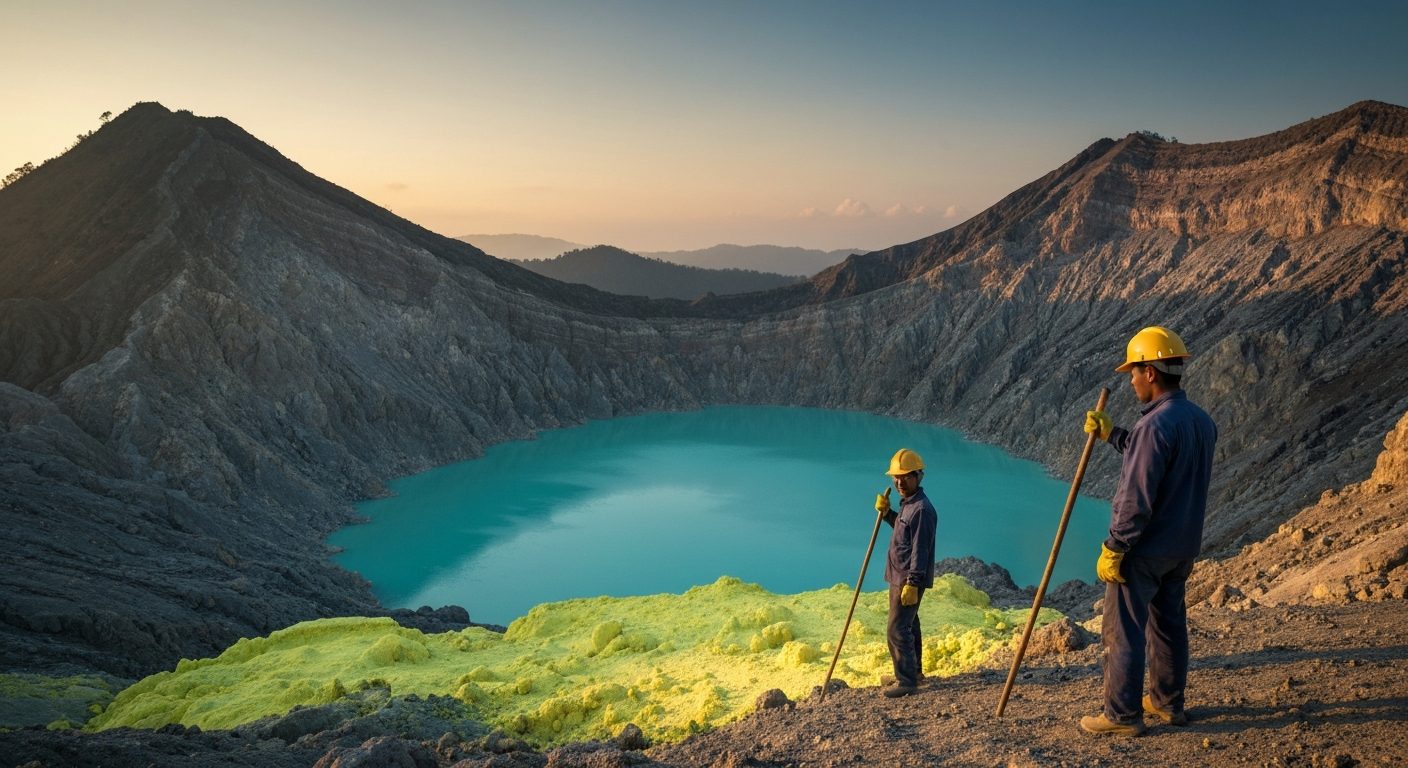
The sulfur miners of Ijen Crater working conditions represent one of the planet’s most physically demanding and hazardous livelihoods. These resilient individuals extract elemental sulfur by hand from the Kawah Ijen volcano, carrying heavy loads up steep, treacherous paths daily. Understanding their daily struggle is crucial for any visitor to the blue fire spectacle.
At Ijen Blue Fire Tours, we believe a visit to Kawah Ijen is more than just witnessing natural wonders; it’s an encounter with a living, working landscape. Our guides have navigated the crater’s paths countless times, accompanying guests to the blue fire. We understand the physical and environmental realities here, including the lives of the men who work the volcano. This guide offers an honest look at the sulfur miners: who they are, the brutal physical reality of their work, what they typically earn, the health toll, and how their trade is now intertwined with tourism.
Who Are the Ijen Sulfur Miners?
The sulfur miners of Kawah Ijen are primarily local Javanese men from the villages surrounding the volcano. For generations, their families have carved a living from the crater’s depths. It is a traditional occupation, passed down through fathers to sons, deeply embedded in the local culture. They are not merely laborers; they are custodians of a unique and demanding heritage.
These men perform one of the world’s last remaining manual sulfur extraction operations. Unlike modern industrial mining, which relies on machinery, the Ijen miners use rudimentary tools: metal bars to break off solidified sulfur, and baskets woven from bamboo to transport it. This manual method, though inefficient by industrial standards, maintains a link to ancestral practices. Each miner develops a profound understanding of the crater’s volatile moods and unpredictable changes, a knowledge gained through years of direct, intimate interaction with the mountain. Their existence is a stark contrast to the modern world just beyond the mountain’s shadow.
The Daily Grind: A Miner’s Journey
A miner’s day begins long before dawn, often around 1:00 AM or 2:00 AM. While tourists trek in the dark to witness the blue fire, the miners are already descending into the crater.
Descent into the Sulfur Basin
The path down into the crater is steep, rocky, and often slippery, especially after rain. Gas masks are essential, even for visitors. For miners, they are a vital, though sometimes imperfect, shield against the acrid fumes. The air thickens with sulfur dioxide, a pungent, choking gas that burns the eyes and lungs. Our experienced guides always emphasize the importance of proper breathing techniques and knowing when to pause.
At the lake’s edge, molten sulfur, glowing bright red, streams from vents in the volcano. As it cools, it solidifies into bright yellow blocks. Miners use steel bars to break these blocks into manageable pieces. The heat at the extraction point is intense, and the air is dense with sulfurous gas. This is the heart of the Ijen blue fire sulfur extraction industrial mining process, albeit on a human scale.
The Ascent with the Load
Once enough sulfur is collected, it is loaded into two bamboo baskets. The weight is astounding: typically 70-90 kilograms (around 154-198 pounds) per load. Some seasoned miners carry over 100 kilograms. This colossal weight is then balanced across their shoulders using a wooden pole.
The climb out of the crater is brutal. It’s a steep, approximately 300-meter (984-foot) ascent to the crater rim, followed by a further 3-kilometer (1.8-mile) trek down the volcano’s slope to the weighing station. Every step is a deliberate, painful effort. The path is uneven, often requiring miners to navigate narrow ledges or slippery inclines. Imagine climbing a challenging mountain trail carrying the weight of a person on your shoulders, all while breathing air heavy with sulfur. This is the reality.
Our treks are timed so guests reach the blue fire before first light. We often share the trail with these miners, both on their descent to the lake and their arduous climb out. Giving them right-of-way is not just courtesy; it’s a necessity. They are at work.
A Miner’s Day: Multiple Trips and Little Rest
Most miners aim for two trips per day. This means descending, extracting, and ascending twice before the afternoon. The physical toll is immense. They often work through minor injuries, exhaustion, and chronic pain. Their commitment is driven by the need to provide for their families.
- Typical Miner’s Load
- 70-90 kilograms (154-198 pounds) of sulfur per trip
- Daily Trips
- 1-2 trips into and out of the crater
- Crater Rim Altitude
- ~2,386 meters (7,828 feet) above sea level
- Descent into Crater
- Approx. 300 meters (984 feet) steep descent to the lake
- Total Trek Distance (one way, from rim to weighing station)
- Approx. 3 kilometers (1.8 miles)
The Price of Sulfur: Health & Economic Realities
The economic reality for Ijen sulfur mine tour workers day income is stark. While it may seem meager by international standards, it often provides a better living than other local agricultural jobs, despite the risks.
Daily Earnings
Miners are typically paid by weight, not by the hour. The price per kilogram of sulfur fluctuates based on market demand. Commonly reported figures suggest miners earn around IDR 800-1,500 per kilogram. With a load of 70-90 kg, a single trip might earn them IDR 56,000 – IDR 135,000 (roughly US$4-9, indicative, varies by market price, last verified June 2026). For two trips, their daily income could range from IDR 100,000 – IDR 200,000 (approximately US$7-14). This sum supports entire families, often covering food, education, and basic necessities. It’s a hard-won income.
The Health Toll
The health consequences of this work are severe and cumulative. Exposure to high concentrations of sulfur dioxide, hydrogen sulfide, and other volcanic gases leads to chronic respiratory issues. Many miners suffer from:
- Respiratory diseases: Silicosis, bronchitis, emphysema, and chronic obstructive pulmonary disease (COPD) are common. The constant irritation and damage to lung tissue reduce their life expectancy significantly.
- Eye irritation: The gases cause severe eye irritation, leading to chronic conjunctivitis and vision problems.
- Joint and spinal injuries: The immense weight carried daily takes a heavy toll on their musculoskeletal system. Herniated discs, severe back pain, knee problems, and premature arthritis are almost inevitable.
- Dental erosion: Acidic gases can erode tooth enamel over time.
- Skin irritation: Direct contact with sulfur and exposure to acidic gases can cause skin rashes and burns.
Despite these risks, access to consistent, affordable medical care is often limited. Many miners rely on traditional remedies or endure their ailments. The visible signs of their labor, such as worn shoulders and bent backs, are a sobering sight.
Ijen Blue Fire Sulfur Extraction: A Raw, Industrial Process
While manual, the scale of sulfur extraction at Kawah Ijen makes it a significant, albeit traditional, industrial operation. The bright yellow sulfur is visible everywhere, from the active vents to the stacked baskets.
The process itself is simple yet effective for extracting pure elemental sulfur. Volcanic gases, rich in sulfur, are piped through a network of ceramic tubes. As these hot gases cool, the sulfur condenses and solidifies into a liquid, which then flows out and hardens into the characteristic bright yellow blocks. This is then broken down manually.
This raw form of Ijen blue fire sulfur extraction industrial mining feeds various industries. The sulfur from Ijen is used in sugar refining, rubber vulcanization, cosmetics, and the production of sulfuric acid, which has numerous industrial applications. The demand, though variable, sustains this unique and ancient trade. It’s a powerful reminder that even in a world dominated by advanced technology, some fundamental resources are still harvested through sheer human will and physical labor.
Ijen Crater Toxic Trekking & Sulfur Miners Impact: Coexistence with Tourism
The rise of tourism, particularly the popularity of the blue fire phenomenon, has profoundly impacted the sulfur miners. For many years, they were almost the sole occupants of the crater in the pre-dawn hours. Now, they share their workplace with hundreds of tourists nightly.
The Double-Edged Sword of Tourism
Tourism presents a complex dynamic. On one hand, it offers new economic opportunities. Many miners now supplement their income by:
- Selling sulfur carvings: Hand-carved sulfur souvenirs are sold to tourists at the rim or along the path. These carvings, often depicting local animals or miniature Ijen volcanoes, provide a direct income stream.
- Working as porters: Some miners offer “taxi” services, pushing or pulling tourists up the steep slopes in carts. This is less physically demanding than carrying sulfur and can offer a relatively stable income.
- Acting as informal guides: With their intimate knowledge of the crater, some miners guide tourists, offering insights into the volcano and their work.
On the other hand, increased tourist traffic can create challenges. The path can become crowded, hindering the miners’ arduous journey. Some tourists, unaware of the cultural context or the dangers, can inadvertently impede the miners or behave disrespectfully. The Ijen Crater toxic trekking sulfur miners impact is a delicate balance between economic benefit and operational challenges.
Our tours are designed to minimize negative impact. We educate our guests on proper trail etiquette and emphasize respect for the working miners. Our guides, deeply familiar with the rhythm of the crater, help facilitate a harmonious coexistence.
Sulfur Miners Kawah Ijen Cultural Experience Ethical: Our Code of Conduct
Witnessing the sulfur miners at work is an memorable part of the Kawah Ijen experience. To ensure your visit is respectful and ethical, we encourage adhering to a simple code of conduct:
- Give Right-of-Way: The miners are at work, carrying immense loads. Always step aside and allow them to pass without interruption, especially on narrow sections of the trail. A simple “permisi” (excuse me) or a nod of respect goes a long way.
- Ask Before Photographing: Their lives are not a spectacle. If you wish to take a photograph, make eye contact and politely ask for permission (“Boleh foto, Pak?” – May I take a photo, Sir?). Respect their decision if they decline. A small tip after a photo is a gesture of appreciation for their time.
- Do Not Touch Their Loads or Equipment: Their baskets are incredibly heavy and balanced with precision. Do not attempt to touch or lift their sulfur loads, even out of curiosity. It can disrupt their balance and cause injury.
- Engage Respectfully (if appropriate): If a miner initiates conversation, engage politely. Many are happy to share aspects of their lives, but avoid intrusive or overly personal questions.
- Consider Tipping or Purchasing Souvenirs Fairly: If you buy a sulfur carving or receive a service (like a “taxi” ride or informal guiding), pay a fair price. While bargaining is common in Indonesia, remember the immense effort behind these items and services. A small tip, given directly to the miner, is always appreciated and makes a tangible difference to their sulfur miners Kawah Ijen cultural experience ethical impact.
- Maintain Distance from Extraction Sites: The areas where sulfur is extracted are dangerous due to heat, fumes, and unstable ground. Follow your guide’s instructions and maintain a safe distance.
This approach ensures that your presence enhances, rather than detracts from, their daily lives. It transforms your visit into a truly Ijen sulfur mining heritage tourist respectful experience.
Supporting the Ijen Sulfur Mining Heritage: Beyond the Trek
Beyond direct interactions, there are broader ways to support the community around Kawah Ijen. Choosing ethical tour operators, like Bali Premium Trip, is a primary step. We work with vetted, licensed East Java guides who understand the local context and prioritize respectful tourism practices.
We also encourage visitors to consider local initiatives that support miner welfare, such as health programs or educational funds for their children. While we don’t directly endorse specific charities, local guides can often provide information on reputable community-based projects. Your engagement, even indirectly, helps sustain this unique Ijen sulfur mining tour explanation miner jobs and their families.
Embarking on an Ijen blue fire trek is an adventure unlike any other. It is a journey through a landscape of raw volcanic power, electrifying blue flames, and the humbling presence of the sulfur miners. Their unwavering spirit in the face of such adversity is a powerful lesson in resilience. When you trek with Bali Premium Trip, you gain not just a visual spectacle but a deeper understanding of this extraordinary place and its people.
Ready to witness the blue fire and the sulfur miners of Ijen, responsibly and respectfully? Our private night treks are expertly arranged and operated by Bali Premium Trip and its vetted, licensed East Java guides. An indicative price for a comprehensive 2-day/1-night Ijen Blue Fire trek package from Surabaya or Bali, including transfers, guide, and park fees, typically ranges from US$150-300 per person (last verified June 2026; prices vary by inclusions and season).
Plan your trip with our Bali Premium Trip reservations team today to discuss your ideal Kawah Ijen experience. You can also reach us via WhatsApp for quick planning assistance.
Frequently Asked Questions
Is it safe to visit Kawah Ijen with the sulfur miners present?
Yes, it is generally safe to visit Kawah Ijen, provided you follow your guide’s instructions and respect the miners’ workspace. Our private night treks are arranged and operated by Bali Premium Trip with experienced local guides who prioritize your safety and ensure respectful interactions. Gas masks are provided and essential for mitigating the effects of sulfur gas, especially in the crater basin.
What should I do if a miner offers to carry me in a cart?
Some miners offer “taxi” services in carts up the steep incline from the blue fire spot to the crater rim. If you find the ascent too challenging, this can be a helpful option. Negotiate a fair price directly with the miner before agreeing to the service. Remember, this is their livelihood, and the effort involved is significant.
Can I help the miners directly?
The most direct way to help is to follow our ethical tourism code: give right-of-way, ask permission for photos (and offer a small tip if taken), and purchase their sulfur carvings fairly. Choosing a reputable tour operator like Bali Premium Trip, which works with licensed local guides and contributes to the local economy, also provides indirect support. Avoid giving unsolicited money or items, which can sometimes create dependency or awkward situations.
What is the best time to see both the blue fire and the miners?
To see the blue fire, you must descend into the crater during the darkest hours, typically between 2:00 AM and 4:00 AM. This is also when the miners are most active, working at the sulfur vents. As dawn breaks, you’ll witness them making their arduous ascent out of the crater with their loads. Our treks are timed precisely for this dual experience.
What kind of gear should I bring to protect myself from the sulfur gas?
Your Bali Premium Trip guide will provide you with a high-quality gas mask, which is crucial for protecting your respiratory system and eyes. We also recommend bringing eye drops, a warm jacket (temperatures can be very cold at night), sturdy trekking shoes, and a headlamp. A scarf or bandana can offer additional protection for your face.
For more detailed information or to customize your Kawah Ijen adventure, please don’t hesitate to plan your trip with us. Our Bali Premium Trip reservations team is ready to assist you, including via WhatsApp for your convenience.