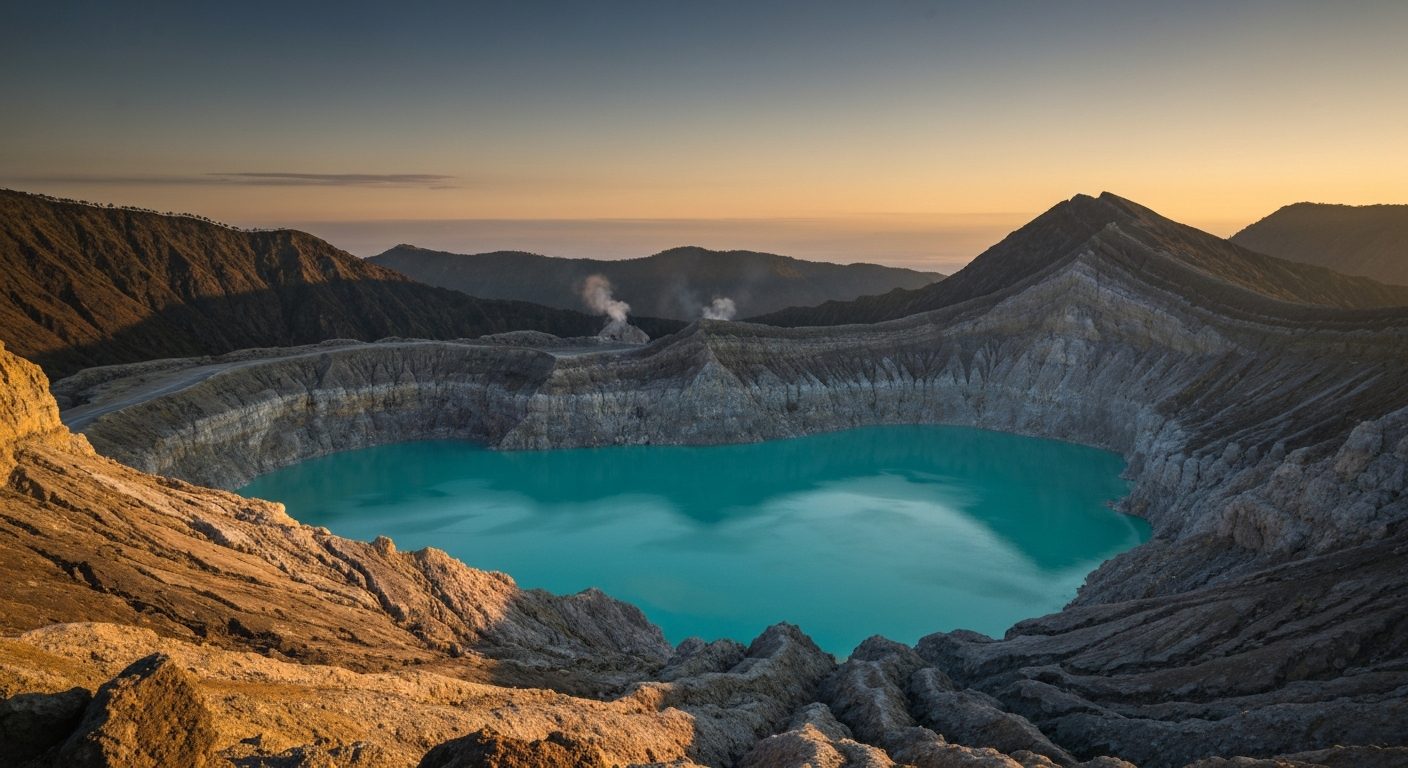
Kawah Ijen crater elevation altitude questions usually have two different answers – and that’s what confuses people. The volcanic complex reaches 2,799 meters above sea level, but the normal crater-rim viewpoint where you watch the blue fire is lower, at roughly 2,386–2,443 meters.
As Ijen Blue Fire Tours’ route researcher for East Java, I keep these figures updated so we plan your night trek on real data, not guesswork. Below is a quick reference you can screenshot.
| Feature | Elevation / Size | Notes |
|---|---|---|
| Ijen volcanic complex high point (Gunung Merapi) | ≈ 2,799 m above sea level | Highest peak of the Ijen caldera complex, often quoted online as “Ijen altitude” |
| Kawah Ijen crater rim viewpoint | ≈ 2,386–2,443 m above sea level | Typical rim area used for blue fire and sunrise views |
| Paltuding basecamp / trailhead | ≈ 1,840–1,860 m above sea level | Main entrance from the Banyuwangi side |
| Trail length Paltuding → crater rim | ≈ 3.0–3.2 km one way | Steady climb on a wide volcanic track |
| Elevation gain Paltuding → rim | ≈ 500–600 m | Plan 1.5–2 hours for most trekkers |
| Ijen crater altitude 2799 meters elevation | Refers to Merapi peak | Source: Smithsonian Global Volcanism Program, Wikipedia |
| Kawah Ijen crater lake depth | ≈ 200 m | Highly acidic, sitting inside the active crater |
| Kawah Ijen crater lake diameter | ≈ 700–722 m across | One of the largest highly acidic lakes in the world |
| Ijen crater lake pH acidity | ≈ 0.13–0.5 pH | Strong sulfuric acid, no swimming of course |
All altitude and lake figures above are based on a combination of the Smithsonian Global Volcanism Program, scientific mapping of the Ijen plateau, and cross-checks with Indonesian sources and GPS tracks our guides record on the ground.
—
1. So, how high is Kawah Ijen exactly?
Ijen’s 2,799 m figure vs what hikers actually reach
Online, you’ll often see “ijen crater altitude 2799 meters elevation”. That number is real — but it describes the highest summit in the Ijen volcanic complex (Gunung Merapi), not the crater rim most people visit at night.
For a standard blue-fire trek with our licensed East Java guides:
- You start from Paltuding basecamp at roughly 1,840–1,860 m.
- You climb around 3.0–3.2 km on a clear, wide track.
- You gain roughly 500–600 m in elevation.
- You reach the Kawah Ijen crater rim elevation at about 2,386–2,443 m.
So your body experiences the altitude change from about 1,850 m to a bit over 2,400 m in 1.5–2 hours. You do not need to climb to 2,799 m to see the blue fire or the turquoise lake.
In short:
- If you’re asking “how high is Kawah Ijen altitude meters for the trek I’ll do?”, think ≈2,400 m.
- The 2,799 m number belongs to the wider Ijen complex, not your night viewpoint.
Why the crater rim numbers vary (2,386 vs 2,443)
You’ll also see several values given for kawah ijen crater rim elevation: 2,386 m, 2,385 m, 2,443 m. All are within a narrow band.
Three reasons for this:
- Different measurement points – The crater rim isn’t a single pin-point. Different GPS readings and mapping projects pick slightly different spots along the rim.
- Different reference datasets – Topographic maps, SRTM satellite data and field GPS tracks don’t always agree to the meter.
- Human rounding – Many guides and websites round to the nearest 5 or 10 m for simplicity.
As a planner, I treat the rim as roughly 2,400 m. That’s accurate enough for:
- Judging temperature (expect it to feel several degrees colder than Banyuwangi or the Bali coast).
- Considering altitude tolerance if you’re coming straight from sea level.
- Comparing Ijen to other volcanoes you may have climbed.
—
2. Paltuding basecamp elevation, trail length and what the climb feels like
Paltuding basecamp elevation and setting
Paltuding is the main access point on the Banyuwangi side of the Ijen plateau. It sits at roughly 1,840–1,860 m above sea level in a cool, often misty forest zone.
Coming up from sea level in Banyuwangi (or from the Ketapang ferry after Bali), you’ll feel the temperature drop:
- Evening at Paltuding is often in the 8–15°C range.
- Humidity can be high, so those temperatures can feel colder than the numbers suggest, especially once you stop moving near the rim.
This basecamp is where:
- Tickets and permits are checked.
- Gas masks are distributed by your guide for the blue fire section.
- Local warungs sell basic snacks, coffee and instant noodles.
Trail length and profile: Paltuding to crater rim
From Paltuding, you follow a 3.0–3.2 km track to the crater rim. The path is wide, volcanic gravel and earth, with a consistent gradient:
- First 1 km – Gentle to moderate, a good warm-up.
- Middle 1.5 km – The steepest section, with several long, steady inclines.
- Final 0.5–0.7 km – Gradual again along the rim approach, often with more wind.
Total elevation gain is around 500–600 m.
Most trekkers, walking at an unhurried pace with a few rests, reach the rim in:
- 1.5–2 hours from Paltuding.
- Fitter hikers sometimes do it in around 1 hour.
- Those taking many photo stops or needing more rest might need up to 2.5 hours.
We usually time private night departures so you:
- Reach the blue fire viewpoint while it’s still dark.
- Have enough time to climb back up from the crater floor, if conditions allow descent.
- Settle along the rim for sunrise.
If you’d like to talk through pacing, porter options or how the climb matches your fitness, just plan your trip with us via email or WhatsApp. Our Bali Premium Trip team adjusts departure times to you, not the other way around.
Is the altitude difficult for most people?
Around 2,400 m is considered moderate altitude. For many healthy travellers:
- You might breathe harder on the steeper part.
- Your heart rate rises faster than at sea level.
- You may feel a bit lightheaded if you sprint, then stop suddenly.
However, full high-altitude illness is rare at Kawah Ijen’s height, especially with a gradual climb. The bigger challenges tend to be:
- Gas exposure if you go down toward the crater lake.
- Cold wind at the rim before sunrise.
- Fatigue from starting around midnight.
This is general context, not medical advice. If you have heart, lung or circulation issues, or you’re unsure how your body handles altitude, speak with your doctor before you go. Then share any guidance with our team so we can plan realistic pacing, extra layers or even a daytime visit instead of the midnight trek.
—
3. Kawah Ijen’s crater lake: size, depth and acidity
The turquoise lake inside Kawah Ijen is central to the mountain’s character. It’s not just colourful; it’s chemically extreme.
Ijen crater largest acidic crater lake in the world?
Scientific sources — including the Smithsonian Global Volcanism Program and multiple geochemical studies — describe the Kawah Ijen crater lake as:
- Among the largest highly acidic crater lakes on Earth.
- Volume reported in the tens of millions of cubic meters.
- Surface diameter roughly 700–722 m across.
You might see slightly different numbers for surface area and volume depending on the study and water level at the time of measurement, but all agree on one thing: the lake is both large and extremely acidic.
How acidic is the Ijen crater lake pH?
The lake is dominated by sulfuric acid, with minor hydrochloric acid and dissolved metals. Reported pH readings are in the range of about 0.13–0.5. That’s more acidic than battery acid.
What this means in practical terms:
- No swimming, no touching, no dipping fingers in “just to feel it”.
- Even staying too long on the lower crater floor without proper wind direction and gas protection is unsafe.
- The brilliant turquoise colour comes from dissolved minerals and suspended particles, not from purity or drinkability.
Our licensed guides monitor wind direction and the current park rules about approaching the lake edge. On some nights, you may be kept at a safer distance on the rim if gas or activity levels make close access risky. Safety comes first; photos can wait.
Kawah Ijen crater lake depth and gas hazards
Depth estimates for the Kawah Ijen lake are around 200 m at maximum. The steep crater walls and depth help trap:
- Hot acidic water.
- Volcanic gases, especially sulfur dioxide and hydrogen sulfide.
From the blue fire area, you’ll see yellow sulfur deposits, piping and workers operating in a very harsh environment. Even with a gas mask, you will:
- Sometimes feel your eyes sting briefly.
- Smell sulfur despite the respirator (that’s normal; masks help but do not filter everything).
- Need to listen carefully to your guide’s instructions about where to stand and how long to stay.
If conditions change, your guide may ask you to start climbing up earlier than expected. That’s not a scare tactic; it’s how we keep the night trek within a safe margin and compliant with the park’s real-time access rules.
—
4. Kawah Ijen’s location: Banyuwangi, Bondowoso and the Ijen plateau
Kawah Ijen Banyuwangi Bondowoso East Java location
Geographically, Kawah Ijen sits on the border of Banyuwangi Regency and Bondowoso Regency in East Java, Indonesia. The crater is part of the Ijen plateau, a wider highland area made of overlapping volcanic structures.
Key context:
- Banyuwangi side – Main access for travellers coming from:
- Bali via the Ketapang–Gilimanuk ferry.
- Banyuwangi town, beaches and lowland stays.
- Bondowoso side – Used more often on overland circuits from:
- Surabaya and the interior of East Java.
- Northern routes that also connect to Mount Bromo or Tumpak Sewu.
Road access on both sides climbs from near sea level up toward the Ijen plateau elevation, which sits roughly between 1,400 and 2,000 m in its populated sections, with peaks rising higher.
Ijen plateau elevation and landscape
The Ijen plateau isn’t a single flat shelf. It’s a complex of calderas, cones, valleys and ridges shaped by repeated eruptions. Within this area you find:
- The Kawah Ijen crater with its acidic lake.
- The higher Merapi peak (≈2,799 m) of the Ijen complex.
- Forested slopes, plantations and several smaller volcanic features.
Driving in at night, you first pass through agricultural land, then higher forest, then the cooler upper plateau before reaching Paltuding. The temperature shift can surprise those coming straight from Bali’s warm coast, so pack:
- A proper outer layer — windproof if possible.
- Gloves and hat or buff for those who run cold.
- A dry shirt to change into if you sweat on the climb; you cool down quickly while waiting for sunrise.
—
5. Ijen UNESCO Global Geopark and why it matters
In 2023, Ijen was designated a UNESCO Global Geopark. This status recognises not just the spectacular crater, but the geological, ecological and cultural value of the entire area.
For visitors, the Geopark status has three main implications:
- More structured conservation efforts
Authorities and local communities are under more pressure — and receive more support — to manage:
- Waste on the trail and around the crater.
- Visitor numbers during peak periods.
- Protection of forest and water resources on the plateau.
- Education focus
You’ll notice more interpretive signs, local guides trained in geology and ecology, and school groups visiting for science learning. It’s not just a photo stop; it’s a living outdoor classroom.
- Stricter rules and occasional closures
Expect:
- Clearer permit systems and identity checks at the gate.
- Closure days such as the first Friday crater cleanup, when direct crater access is usually off-limits for volunteer and staff work.
- Possible temporary shutdowns if volcanic activity or gas levels rise above safe limits.
We factor all of this into our trip planning. Before we confirm any Kawah Ijen trek, I cross-check:
- Current park regulations and hours.
- Any announced maintenance or cleanup days.
- Recent volcanic activity updates from the Indonesian authorities.
If your desired date falls on a likely closure day, our team will propose alternatives or adjust the wider East Java itinerary (for example, reordering Bromo – Tumpak Sewu – Ijen legs).
—
6. Altitude, fitness and planning your own night trek
How Kawah Ijen compares to other volcanoes
To help you judge kawah ijen crater elevation altitude against other climbs you might know:
- Kawah Ijen crater rim (~2,400 m)
- Shorter, steeper climb than many “sunrise hills”, but lower than big Himalayan or Andean treks.
- Mount Bromo viewpoint (around 2,300–2,400 m)
- Similar absolute altitude, but Bromo access is often by jeep and short walks rather than a full 3 km climb.
- Popular day hikes at 1,500–2,000 m
- Ijen is slightly higher, and you start the effort in the coldest part of the night.
So even if you’ve done hikes at similar altitudes, expect Ijen to feel different because of:
- The night start (fatigue).
- The gas mask weight and breathing resistance.
- The cold wind at the rim waiting for sunrise.
General fitness notes (not medical advice)
In planning terms, the Ijen trek is usually manageable if you can:
- Walk uphill continuously for 60–90 minutes with short rests.
- Handle cool temperatures and possibly some wind.
- Feel comfortable walking on uneven gravel in the dark using a headlamp.
Many travellers do it without regular training, but they arrive with:
- Suitable shoes with grip.
- Layers they can adjust as they warm up and cool down.
- Willingness to walk slowly and consistently, rather than racing.
We’ve also taken people who:
- Arrange a porter or trolley service for part of the ascent (availability and pricing vary; this is arranged on-site through local communities).
- Choose a private trek so the guide paces the climb entirely around them.
For any specific health condition or pregnancy, your personal doctor should make the final call. Our role is to translate that guidance into realistic on-the-ground plans — shorter walks, alternate viewpoints, or different timing. You can always plan your trip and use WhatsApp to share your situation confidentially with our reservations team.
Indicative costs and how we operate
Pricing for a private Kawah Ijen night trek varies with:
- Start point (Bali, Banyuwangi, Bondowoso, Surabaya).
- Group size.
- Season and how it links with Bromo or Tumpak Sewu.
As a rough planning benchmark (last verified June 2026):
- A one-night private Ijen tour from Banyuwangi typically ends up around US$80–160 per person for 2–6 guests, including transport, local guide and standard entry fees.
- A 3–4 day circuit combining Ijen with Bromo and waterfalls from Bali or Surabaya often lands in the US$280–550 per person range for small private groups.
These are indicative ranges only, not fixed quotes. Travellers book directly with our Bali Premium Trip reservations team at transparent, published rates — no third-party markup. On your invoice you’ll see clearly which parts we operate directly and which services (such as park jeeps or additional local porters) we arrange through licensed East Java partners.
—
7. Summary: key Kawah Ijen elevation and geography facts
To wrap the key geography stats in one place:
- Ijen crater altitude 2799 meters elevation – Refers to Merapi, the highest peak in the Ijen complex, not the usual night-trek viewpoint.
- Kawah Ijen crater rim elevation 2443 meters (≈2,386–2,443 m) – The band covering the typical rim viewpoints for blue fire and sunrise.
- Paltuding basecamp elevation – Around 1,840–1,860 m, with a trail length of roughly 3.0–3.2 km to the rim and ≈500–600 m elevation gain.
- Ijen crater lake pH acidity sulfuric acid level – Extremely acidic, with pH around 0.13–0.5, dominated by sulfuric acid.
- Kawah Ijen crater lake depth diameter size – Around 200 m deep and ≈700–722 m across, making it one of the largest highly acidic crater lakes in the world.
- Kawah Ijen Banyuwangi Bondowoso East Java location – On the border between the two regencies, part of the wider Ijen plateau volcanic system.
- Ijen UNESCO Global Geopark facts – Recognised in 2023, which supports improved conservation, education and structured visitor management.
If you build your plans around these figures, you have a realistic sense of the climb, the conditions and the nature of the volcano you’re visiting. For the rest — gas dynamics, current access rules, and how your particular night will unfold — that’s what our on-the-ground logistics team and East Java guides are here for.
Whenever you’re ready to turn the data into an itinerary, you can plan your trip directly with our Bali Premium Trip reservations team via email or WhatsApp and we’ll map the right route into Ijen for you.
—
What is the actual elevation of Kawah Ijen’s crater rim?
The main Kawah Ijen crater rim viewpoints sit at roughly 2,386–2,443 m above sea level. Different sources quote slightly different numbers, but for planning, think of it as about 2,400 m high.
Is Kawah Ijen really 2,799 meters high?
The 2,799 m figure refers to Merapi, the highest summit in the broader Ijen volcanic complex, not the standard crater rim used for blue fire and sunrise treks. Normal visitors do not climb to 2,799 m.
How long and steep is the hike from Paltuding to the crater?
The track from Paltuding basecamp to the crater rim is about 3.0–3.2 km one way, with around 500–600 m of elevation gain. Most people take 1.5–2 hours at a steady, unhurried pace.
Is the Ijen crater lake safe to touch or swim in?
No. The Ijen crater lake has a pH of roughly 0.13–0.5, dominated by sulfuric acid, and is highly corrosive. It is strictly for viewing only; touching or entering the water would be dangerous.
Where exactly is Kawah Ijen located?
Kawah Ijen lies on the border between Banyuwangi and Bondowoso regencies in East Java, Indonesia, within the higher Ijen plateau. Access is usually from the Banyuwangi side via Paltuding basecamp or overland from Bondowoso on longer East Java circuits.