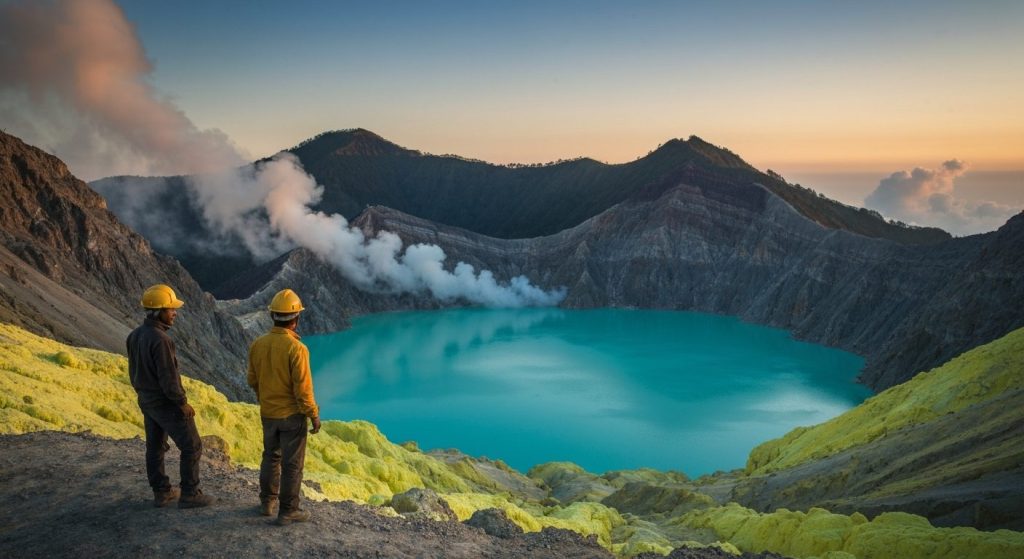
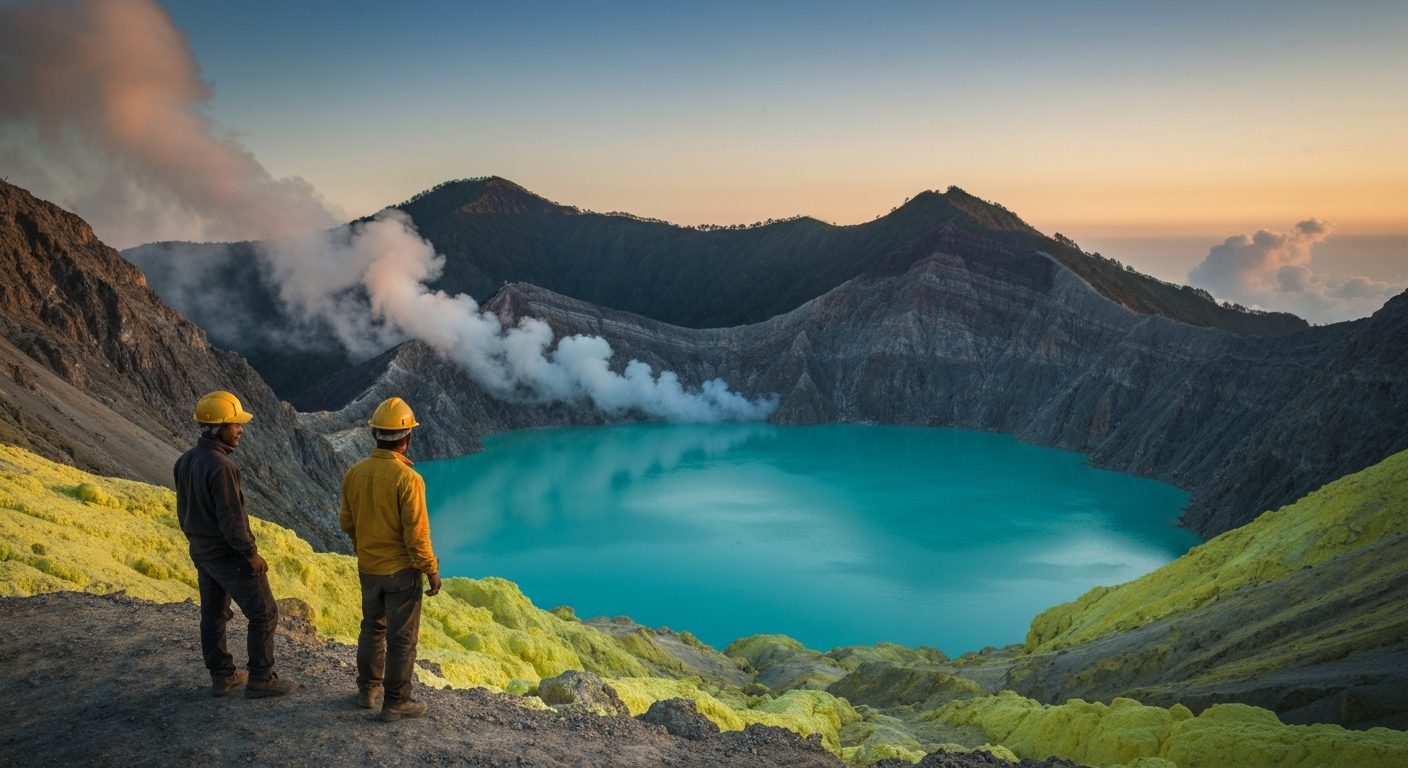
An ijen sulfur miners tour is a guided night hike into Kawah Ijen where you quietly observe East Java’s traditional sulfur mining beside the crater’s electric-blue fire and highly-acidic turquoise lake. On this page I explain exactly what you see, how the miners work, what the hike demands of your body, and how we run this ijen sulfur miners tour experience safely and respectfully.
As Kawah Ijen Trek & Volcano Editor for Ijen Blue Fire Tours, I’ve walked this path more than a hundred times. I know the feel of the first sulfur gust on the switchbacks, the weight creak in a miner’s bamboo pole, and the moment your eyes finally adjust and the blue fire shows itself.
This is the honest version of what you’ll experience.
—
What Is The Ijen Sulfur Miners Tour & Turquoise Crater Lake Experience?
An ijen crater lake sulfur miners tour combines three linked stories in one long night:
- The physical night hike up to the crater rim and down to the mining area
- The human world of the miners: men carrying 70–90 kg loads of bright yellow sulfur by hand
- The geology: blue fire, active vents, and the largest highly-acidic turquoise crater lake in the world
You hike in the dark for roughly 3 km to the rim, then about 600–700 m down a rocky path into the crater. From there you witness:
- Blue fire flames flickering from sulfur vents (on suitable nights)
- Pipes feeding molten sulfur into pools, hardening into neon yellow slabs
- Miners breaking, loading, and hauling sulfur up from 2,200–2,300 m elevation
- The first light revealing the ijen crater lake acidic turquoise water below you
Bali Premium Trip plans and sells the tour directly. On the mountain we work with licensed East Java guides and official park services for transport, gas masks and permits.
—
Route Overview: From Trailhead To Crater Lake
Where the trek starts
Most guests approach Kawah Ijen from Banyuwangi in East Java, or via an organized transfer from Bali across the Gilimanuk–Ketapang ferry. From the park entrance at Paltuding, you start hiking at around 1,850 m above sea level.
Typical timings:
- Hotel pick-up (Banyuwangi side): around 00:00–01:00
- Arrival at Paltuding: 01:30–02:00
- Start hiking: roughly 02:00
- Reach crater rim: about 03:30–04:00 (pace-dependent)
- Descent to sulfur mining area: 20–40 minutes
- Begin ascent out of crater: usually after sunrise
- Return to Paltuding: 07:00–08:30
Actual times vary with your pace, road conditions, and current park regulations for blue fire access.
The climb to the crater rim
The trail from Paltuding to the rim is about 3 km, gaining roughly 500 m of elevation. The first 2 km are a steadily rising wide path, then the grade softens slightly on a more undulating final kilometer.
Expect:
- Hiking time: 1.5–2 hours for most reasonably fit guests
- Surface: compact volcanic gravel and earth, dusty in the dry season, sometimes muddy after rain
- Gradient: some sections feel steep, especially the first 1.5 km
This is not technical mountaineering. But in the dark, with altitude and sulfur in the air, it feels harder than the numbers suggest.
The descent into the sulfur basin
From the rim, a steeper, rockier path drops roughly 150–200 vertical metres to the mining area. This part is where most people realize why a kawah ijen yellow sulfur mining guide matters.
Key realities:
- Steepness: some sections require careful step placement, but no ropes
- Surface: shattered rock, loose gravel, and worn steps carved into the slope
- Congestion: you share the path with miners coming up with full loads in the dark
Here your guide manages pace and timing so you are not pushing past miners under heavy strain. Gas masks go on if the wind turns and sulfur gas thickens.
—
Who Are The Sulfur Miners Of Kawah Ijen?
Hand-carried sulfur loads
The miners you see are freelance workers who:
- Break hardened sulfur from the flows near the vents
- Load it into two woven baskets on a bamboo yoke
- Carry it up from the crater floor to the rim
- Then haul it several more kilometers down to a weighing station below
Typical loads range from 70–90 kg. Some carry more. They do several trips per day, climbing and descending the same path you use, but under a load that would challenge many athletes.
Work conditions you will actually see
As dawn comes, you’ll see:
- Men working close to sulfur vents, often using wet cloths as basic face covering
- Simple tools: metal bars, wooden sticks, or iron rods to break the sulfur
- Baskets mended and re-mended; shoulder calluses shaped by bamboo
- Rubber boots, sometimes sandals, sometimes bare hands
Photography is welcome, but respect is non-negotiable. We ask guests not to block the path, not to urge miners to pose or re-enact scenes, and to always give right of way to loaded carriers.
Paying and tipping miners: honest guidance
There are informal habits around tipping and small purchases:
- Miners may offer sulfur carvings or small pieces for sale
- Some will agree to a quick posed photo, often expecting a small tip
Our stance:
- You are free to buy souvenirs and tip respectfully
- We strongly discourage paying for dangerous “extra” stunts or asking miners to step closer to vents or flames
- Tips should never be conditional on a risky act
Your guide will help you understand what is reasonable and safe in current local practice.
—
How Sulfur Extraction Works At Kawah Ijen
The industrial set-up: pipes and pools
Kawah Ijen’s sulfur extraction is a hybrid of basic infrastructure and intense manual labor. You’ll see:
- A network of ceramic or iron pipes diverting volcanic gases from fumaroles
- As gases cool in the pipes, sulfur condenses and drips out as molten liquid
- This molten sulfur collects in shallow ground pools and hardens into bright yellow crusts
- Miners then break the crusts into chunks and load them into baskets
This is small-scale industrial mining feeding broader sulfur demand in Indonesia, from fertilizer production to local manufacturing. On your ijen sulfur extraction industrial mining walk-through, your guide will point out where new pipes have been installed, where old ones have cracked, and how the miners adapt.
Why the gas is so harsh
The gas comes primarily from volcanic fumaroles rich in sulfur dioxide and hydrogen sulfide. When concentrated and wind-blown, it can sting eyes and lungs in seconds.
Important points:
- Gas pockets: even on a “clear” night, pockets of dense gas can drift over the trail
- Masks: gas respirators substantially reduce irritation, but they are not magic shields
- Wind direction: a small shift can suddenly make an area uncomfortable
Your guide will judge when to stay, when to move, and where to stand so the wind carries most gas away from you.
—
The Ijen Crater Lake: Earth’s Giant Acidic Turquoise Pool
Largest highly-acidic crater lake
Below you lies one of the most concentrated large acid lakes on Earth. The ijen crater lake acidic turquoise water has a pH near 0. This is similar to strong battery acid.
The lake’s key facts:
- Location: inside Ijen’s main crater, roughly 1 km across
- Color: intense turquoise/blue-green under daylight due to dissolved minerals and acidity
- Chemistry: dominated by sulfuric and hydrochloric acids, plus dissolved metals
You do not swim here. You don’t even approach the waterline on a normal kawah ijen crater tour. The lake is observed from the rim or high on the crater wall, where the gases and terrain are manageable.
Why the color is so intense
The ijen crater lake acidic turquoise hue comes from:
- High concentration of sulfate and metals scattered light differently at various depths
- Fine suspended particles giving a milky glow in early light
- Rising steam and gases altering the appearance moment by moment
On clear mornings, the contrast of yellow sulfur, grey rock, and brilliant lake is one of the more unusual volcanic scenes you can stand and watch. No filters required.
—
The Blue Fire: Timing, Reality, And Limits
What the blue fire really is
Blue fire is not “blue lava”. It’s the glow of burning sulfuric gases igniting as they escape from vents at high temperature.
You will typically see:
- Electric-blue flares low on the crater wall near the mining area
- Occasional small tongues of blue sliding down over rock where gases ignite
- Shifting, pulsing flames that change with wind and gas pressure
The effect is brightest between roughly midnight and 04:00, and fades quickly as ambient light increases.
Visibility and safety
Important honesty:
- The park sometimes restricts access into the crater when gas concentration or weather is unsafe
- Heavy rain, very strong wind, or new volcanic activity can change access with little notice
- On some nights, blue fire is faint or partially obscured by steam and low cloud
We never guarantee a particular intensity of blue fire. Our first filter is always current safety guidance from park authorities and local monitoring.
—
What The Hike Actually Feels Like: Difficulty & Conditions
Fitness and altitude
The numbers:
- Trailhead altitude: roughly 1,850 m
- Rim altitude: around 2,386 m
- Total altitude gain: ~500 m to the rim, plus the descent/ascent in and out of the crater
- Total walking distance: usually 6–8 km for the full night, depending how far you explore the rim
Most moderately active adults can complete the walk with frequent breaks. You will notice:
- Shortness of breath earlier than at sea level
- Legs burning on the steeper early sections
- Occasional need to pause when sulfur gas drifts across the path
Slow, steady pacing wins here. Your guide will find a rhythm that matches the slowest person in the group.
Night cold and clothing
Temperatures near the rim just before dawn can drop toward 5–10°C, especially in the dry season. Wind can make it feel cooler.
Recommended layers:
- Base: moisture-wicking T-shirt or long-sleeve
- Mid: light fleece or sweater
- Outer: windproof jacket or rain shell
- Lower body: long trekking pants
- Extras: light gloves and a beanie or buff for the rim
You start warm from the climb, then cool quickly when you stop moving near the top. Having one spare warm layer you can put on for rest stops makes a big difference.
Footwear and terrain
You’ll be walking on:
- Volcanic gravel tracks
- Hard-packed dirt paths
- Sections of broken rock inside the crater
Closed shoes with good grip are essential. Light hiking shoes or trail runners work better than flat-soled sneakers, especially for the descent to the mining area.
—
Safety, Gas Masks, And Respect For Miners
Gas masks: what we provide and how they’re used
On an ijen sulfur miners tour experience, every guest receives a gas respirator at or before the crater rim. We arrange these through our licensed local partners in line with park requirements.
Important details:
- Masks help reduce irritation from sulfur dioxide and other gases
- They work best when fitted properly and worn before you walk into dense gas
- They do not create a “no-risk” zone; if gas gets too strong or you feel unwell, we move
Your guide will brief you on how to adjust the straps, check the seal, and when to keep the mask off (open air) so you don’t overheat or feel claustrophobic.
How we move around miners
Miner-safety etiquette on the trail:
- Always give way to loaded miners on steep parts; step aside early
- Avoid shining bright headlamps directly into their eyes at close range
- Do not stand in narrow spots to take photos when miners are approaching
- Keep your trekking poles, bags, and elbows tight in crowded sections
Our guides are used to coordinating guest movement so miners can work with minimal disruption. Their work is already hard enough.
Photography and filming: ethical guidelines
You are welcome to photograph and document what you see, with a few simple principles:
- Ask before taking close portraits, especially if you want a miner to look directly at the camera
- Don’t pressure anyone to repeat a heavy lift or stand for long in gas
- If you share your work later, do so with basic context about conditions and risks, not as a “thrill” show
We walk this crater often. The miners see many groups. The guests who get the warmest response are those who treat people as people, not props.
—
What’s Included In A Kawah Ijen Sulfur Miners & Crater Lake Tour
Tour logistics can vary slightly by season and your starting point, but a typical private kawah ijen crater tour with Bali Premium Trip includes:
- Private vehicle transfer from your hotel (Banyuwangi side, or from Bali with ferry crossing arranged)
- Licensed local mountain guide for your group
- Gas mask rental for each participant
- Entrance permits and park fees, using official channels
- Headlamps for guests who don’t bring their own
- Hot drink or light snack at or after the hike (varies by package)
Overnight stays, additional East Java volcanoes, or combined itineraries with Bromo or waterfalls can be added on request.
Indicative pricing and group sizes
Exact costs depend on your departure point (Bali vs. Banyuwangi), season, and how many nights and islands you combine. To give a real-world anchor:
- A privately guided ijen blue fire tour including sulfur miners visit price typically lands around US$90–180 per person for a one-night program from Banyuwangi, assuming 2–4 guests and last verified June 2026 conditions
- From Bali, including return road transfer and ferry, indicative ranges often run higher, for example roughly US$160–260 per person for a short 1–2 night package with a small private group, last verified June 2026
These are not fixed quotes; they’re working ranges so you can budget sensibly.
Group sizes:
- Private tours: commonly 2–6 people
- Larger private groups: possible, but we add assistant guides to keep the pace manageable and safety briefings clear
For an exact quote tailored to your route and dates, you can plan your trip with our Bali Premium Trip reservations team by email or WhatsApp.
—
Comparison: Rim-Only Visit vs Full Sulfur Miners Descent
- Route
- Rim-only: hike to crater rim and stay above; Full descent: continue down to mining area near vents.
- Total effort
- Rim-only: ~6 km round-trip, 500 m gain; Full descent: +1–1.5 km and additional 150–200 m vertical each way.
- Exposure to gas
- Rim-only: lower, usually short gusts; Full descent: higher, closer to vents, gas masks important.
- View of miners
- Rim-only: mostly see miners on trail and from above; Full descent: close view of extraction and loading.
- Blue fire visibility
- Rim-only: distant, sometimes partly hidden; Full descent: closer view if park access allows.
- Recommended for
- Rim-only: guests with asthma, heart issues, or limited mobility (after medical consultation); Full descent: reasonably fit guests ready for steeper, rougher ground.
If you’re unsure which route suits you, describe your fitness and concerns when you plan your trip. We can advise via WhatsApp before you commit.
—
How We Operate: Bali Premium Trip & Local Partners
Direct booking with transparent structure
Ijen Blue Fire Tours is part of Bali Premium Trip. You book directly with our reservations team, not through anonymous marketplaces with shifting operators.
We:
- Set clear inclusions and exclusions before you pay
- Use licensed drivers, local guides, and official park channels
- Share realistic timing and difficulty, not marketing slogans
Many of the same guides work with different companies across the year. The difference lies in how they are scheduled, briefed, and supported. We keep group sizes reasonable and itineraries honest.
Licensed local guides in East Java
On the mountain, day-to-day safety decisions belong to the licensed East Java guides who lead you:
- They monitor wind, gas, and weather on the approach
- They enforce park instructions about access into the crater
- They match the route to the slowest guest in your private group
I write the trek guides and planning material. They execute it on the ground.
—
Is The Ijen Sulfur Miners & Crater Lake Tour Right For You?
This ijen sulfur miners tour is a good match if:
- You’re comfortable with a 3–4 hour round-trip walk at altitude
- You can manage rocky, uneven ground in the dark
- You’re prepared for short, intense sulfur smells and wearing a gas mask part of the time
- You’re interested in the real story of labor and geology, not just a quick photo
It may not be suitable if:
- You have uncontrolled asthma, serious heart or lung conditions, or severe anxiety in confined/low-visibility environments
- You struggle significantly with steep hills, even at sea level
- You are pregnant and have been advised to avoid gas exposure and strenuous activity
If you’re unsure, describe your situation when you plan your trip. We’ll answer over email or WhatsApp and help you decide with clear expectations.
—
What time do we start hiking?
Most tours begin the ascent from Paltuding between 02:00 and 02:30, aiming to reach the crater rim around 03:30–04:00 and, if conditions permit, descend to see blue fire before first light dilutes the glow.
Can I visit the miners and see blue fire without going down into the crater?
You can stay at the rim and still see miners on the trail and sometimes a distant blue glow, but the full close-up experience of the sulfur extraction and blue fire usually requires descending partway into the crater, subject to park safety rules.
Are children allowed on the ijen sulfur miners tour?
Older children with good fitness and experience on rough trails can sometimes join with parental responsibility, but due to gas exposure and night hiking, we typically recommend this tour for teenagers and above rather than very young children.
What should I bring for the night hike?
Bring closed shoes with good grip, a warm jacket, long pants, a simple daypack, at least 1–1.5 liters of water, snacks, a headlamp if you have one, and a buff or scarf; we provide gas masks and can supply lights for those who need them.
Can weather or volcanic conditions cancel the tour?
Yes, strong wind, heavy rain, landslides, or elevated volcanic alerts can cause park authorities to restrict crater access or close the area; if that happens, we adjust the itinerary to a rim-only visit or reschedule or refund according to current park and booking conditions.